
What is cross-channel marketing? Definition, strategy, and examples
Published on April 01, 2026/Last edited on April 01, 2026/12 min read

Team Braze
Nearly half of marketers say they lack the tools to orchestrate coordinated cross-channel experiences—and customers feel that gap. They move between email, apps, SMS, and in-product moments, often within the same day, and they notice when the experience doesn't hold together.
Cross-channel marketing is the discipline that closes that gap. By coordinating messaging across channels based on real customer behavior and context, brands can meet people where they are, respond to what they actually do, and build the kind of consistency that turns casual users into loyal customers. The brands that get this right don't just see better engagement—they see it in retention, repeat purchases, and lifetime value.
This guide covers everything you need to understand cross-channel marketing clearly—what it is, how it works, and how to get it right—so you can confidently build a strategy that works for your brand.
Quick overview:
- Cross-channel marketing is the coordinated use of multiple connected channels—such as email, SMS, push, and in-app messaging—to deliver consistent, behavior-driven communication across the customer journey. Unlike multi-channel marketing, cross-channel marketing uses shared customer data so that each interaction informs the next.
Key Takeaways
- Cross-channel marketing coordinates messaging across multiple connected digital channels (email, SMS, push, in-app, etc.) using shared customer data and real-time behavioral signals to create a consistent, relevant, and responsive customer experience that drives higher engagement, retention, and lifetime value.
- Unlike multi-channel marketing where channels operate independently, cross-channel marketing ensures each interaction informs the next, avoiding disconnected or redundant messaging that can erode trust and reduce customer engagement. It is distinct from omnichannel marketing by focusing primarily on digital channels, while omnichannel includes all touchpoints including physical and service interactions.
- A strong cross-channel strategy relies on intentional channel selection, real-time behavior-triggered messaging, and personalization powered by first-party and zero-party data. Combining in-product (in-app, in-browser) and out-of-product (email, push, SMS) messaging creates a continuous engagement loop that significantly boosts purchase rates and customer loyalty.
What is cross-channel marketing?
Cross-channel marketing is the coordinated use of multiple digital channels—such as email, push notifications, SMS, and in-app messages—to deliver consistent, relevant messaging throughout the customer journey.
Every channel is connected and shares data, so that a behavioral signal in one place—a purchase, a lapsed session, a browsed category—directly shapes what a customer receives next. Cross-channel messaging creates an experience that feels responsive, coherent and relevant, rather than a series of disconnected interactions across separate platforms.
Why is cross-channel marketing important?
Cross-channel marketing is important because customers don't experience brands one channel at a time. They move between email, apps, websites, and messaging platforms fluidly—often within the same day—and they expect the experience to move with them. When it doesn't, the disconnect is noticeable: a promotion for a product already purchased, a follow-up that ignores a recent interaction, a push notification with no relation to what just happened in-app.
Those gaps erode trust, drive unsubscribes, and make customers less likely to engage over time. Brands that coordinate across channels avoid these pitfalls by maintaining a continuously updated view of each customer that informs every message, regardless of where it's delivered. Even with AI now widely adopted—60% of marketers are already using it to support personalization across channels—48% still say they lack the tools needed to orchestrate coordinated cross-channel experiences, meaning the personalization ambition often outpaces the infrastructure to deliver it.
Cross-channel vs. single-, multi-, and omnichannel marketing
These four terms get used interchangeably, but they describe meaningfully different approaches to customer engagement. Here's a quick definition of each before we get into the detail:
Single-channel marketing is engaging customers through one channel only—for example, email, but not SMS or push.
Multi-channel marketing means being present on multiple channels, but each operates independently, with its own strategy and messaging, and no shared data between them.
Cross-channel marketing coordinates messaging across multiple channels using shared customer data, so what happens on one channel directly informs what a customer receives on the next.
Omnichannel marketing extends that connected vision to every touchpoint a customer has with a brand—digital and physical—including in-store, customer service, and beyond.
Single-channel vs. cross-channel engagement
Single-channel marketing has real value. A well-timed email, a relevant push notification, a perfectly placed in-app message—any one of these can drive meaningful action. But a single channel can only reach customers when they happen to be paying attention to it. There's no fallback, no reinforcement, and no way to respond to behavior that happens somewhere else.
Cross-channel engagement addresses that directly. By coordinating messaging across multiple connected channels, brands can reach customers where they actually are, respond to what they actually do, and build the kind of consistency that compounds over time into stronger retention and higher lifetime value.
Cross-channel vs. multi-channel marketing
Multi-channel marketing uses multiple platforms but runs them independently. A customer might receive an email about a product they already bought, a push notification about a sale they've already used, and an SMS unrelated to anything they've shown interest in. Each message is correct for its channel. Together, they feel disjointed.
For digital teams focused on driving measurable engagement outcomes, cross-channel marketing is the more practical and execution-ready model—coordinated by design, and built to respond to what customers actually do.
Cross-channel vs. omnichannel marketing
Omnichannel shares cross-channel's ambition—connected, consistent customer experiences—but at a broader scope. Cross-channel focuses on coordinating digital messaging channels, while omnichannel extends that vision to every touchpoint a brand has with a customer, including in-store, customer service, and the full blend of physical and digital interaction.
Omnichannel is often the long-term goal. Cross-channel is what most digital teams are building and executing right now—and for brands focused on driving retention, purchases, and lifetime value through messaging, it's the most achievable starting point with significant, measurable impact.
Cross-channel marketing starts with two message types
Before choosing which channels to use, it helps to understand the two fundamental ways brands can reach customers—because the distinction shapes everything about how a cross-channel strategy is built.
The first is in-product messaging—communication that reaches customers while they're actively using your app or website. These are pull messages, meaning the customer has already shown up, and the message meets them in that moment of active engagement. In-app messages, in-browser notifications, and content cards all fall into this category. They work with existing intent rather than trying to create it.
The second is out-of-product messaging—communication that reaches customers outside of your product entirely. Push notifications, email, SMS, and messaging apps like WhatsApp are all out-of-product channels. These are the channels that prompt customers to return—bringing a brand back into someone's attention when they're not actively thinking about it.
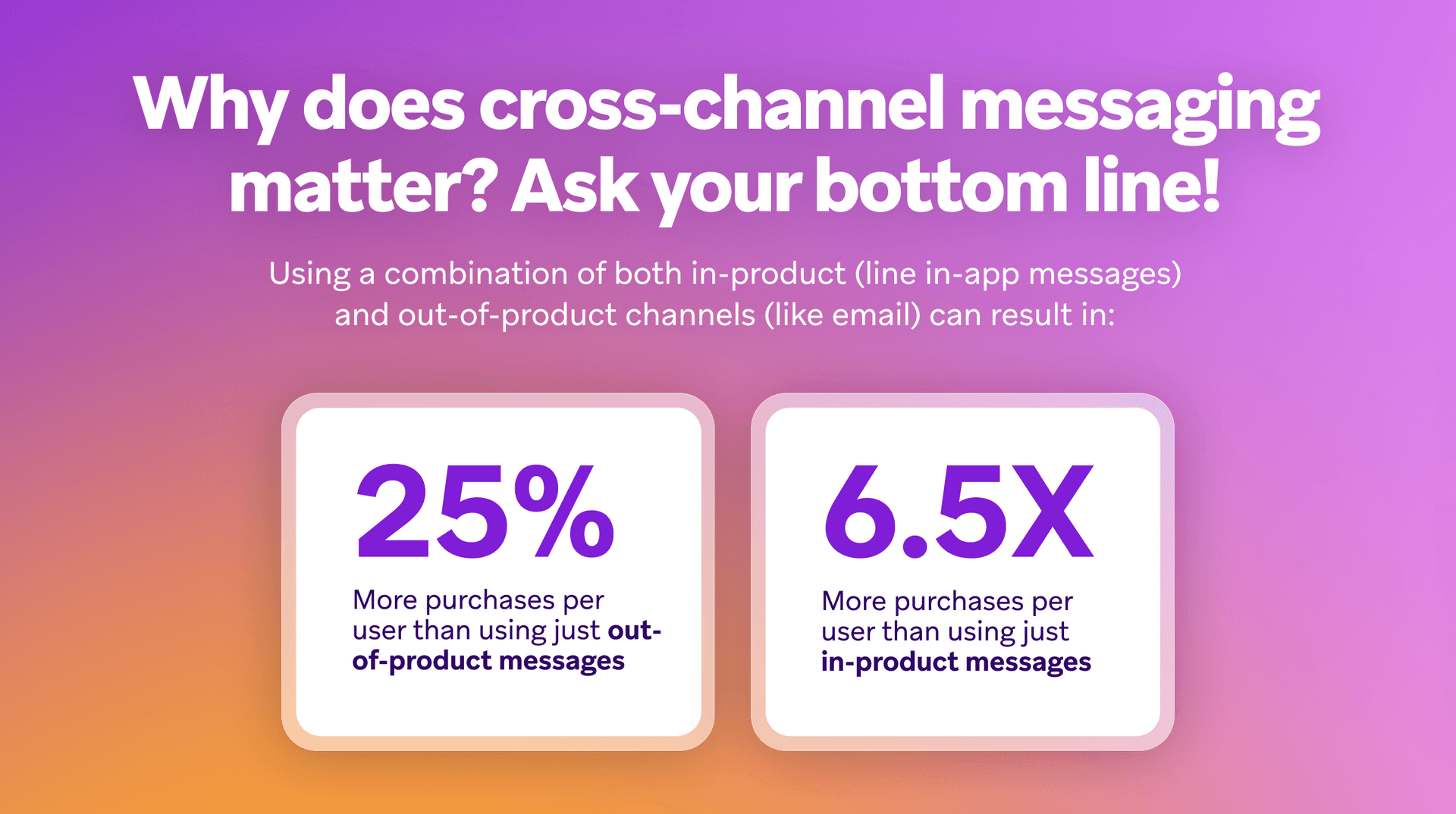
Both types serve a purpose, but neither is sufficient on its own. Our analysis from the Braze 2024 Global Engagement Review found that messaging users on a combination of in-product and out-of-product channels can result in 25% more purchases per user than using just out-of-product channels and 6.5X more purchases per user than using just in-product channels.
Out-of-product messaging drives customers back to an experience; in-product messaging deepens it once they arrive. Brands that rely only on one type end up either broadcasting into a void or only ever speaking to the already-engaged. Used together, with each type informed by the same behavioral data, they create a continuous loop—one that keeps customers engaged across the full arc of their relationship with a brand.
Key components of a strong cross-channel marketing strategy
Knowing what cross-channel marketing is and actually building a strategy that delivers are two different things. The brands that see the strongest results make deliberate decisions about how their channels work together—and that discipline is what separates genuine engagement from added noise.
Cross-channel customer engagement
That starts with intentional channel selection. The right mix depends on where customers actually spend their time, what type of message is being sent, and what each channel does best. Deliberate choices here are what makes cross-channel customer engagement feel coherent rather than cluttered.
Timing and real-time relevance matter just as much. Cross-channel engagement works best when it's triggered by actual behavior—a session started, a purchase abandoned, a milestone reached—rather than scheduled in advance for a broad audience. According to the Braze 2026 Global Customer Engagement Review, only 55% of marketers are updating and leveraging customer information in real time. For the brands that do, the quality of engagement reflects it.
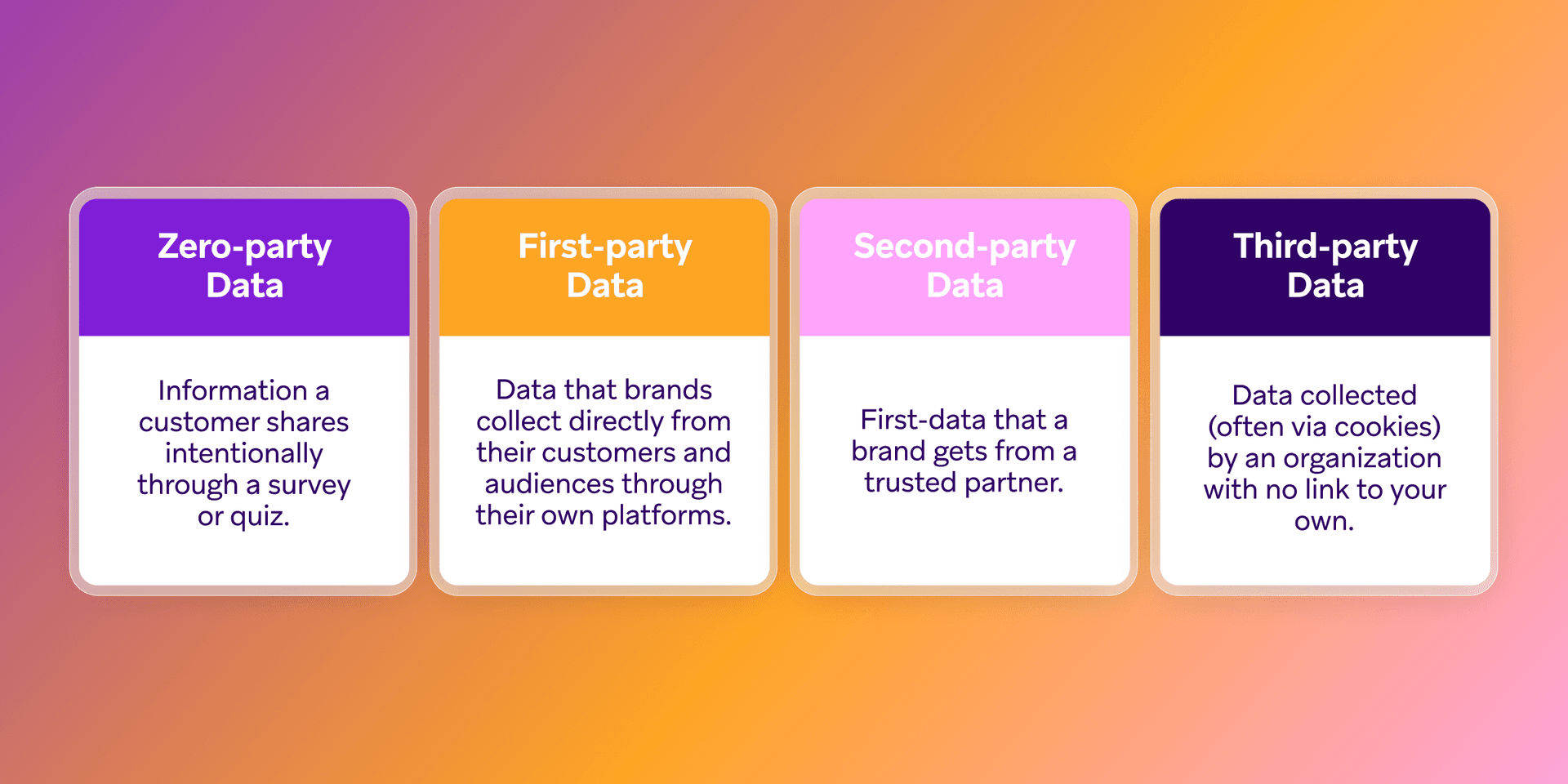
Underpinning all of this is personalization powered by first-party data—shaping what customers receive, when, and on which channel based on their behavior, purchase history, and preferences. The Braze 2026 Global Customer Engagement Review found that only 53% of consumers feel brands are accurately predicting their wants and needs, a gap that a stronger first-party data strategy can meaningfully close.
Cross-channel measurement is what allows the strategy to improve over time. Channel-by-channel reporting tells only part of the story. The more meaningful questions are about the journey as a whole, such as which channel combinations drive retention, where customers drop off, and which sequences lead to conversion.
Channels used in cross-channel marketing
Cross-channel marketing draws on a range of channels, each with its own strengths, audience behaviors, and best-use cases. The right mix will vary by brand and customer base, but these are the channels most commonly used as part of a coordinated cross-channel strategy.
- Email: versatile and high-performing, well-suited to detailed, considered communication such as personalized recommendations, lifecycle campaigns, and re-engagement.
- Mobile push and web push: built for immediacy, reaching customers directly on their devices for time-sensitive messages, real-time alerts, and nudges that bring users back to an experience.
- SMS: direct, personal, and fast, with high open rates, making it effective for urgent communications, exclusive offers, and transactional messages.
- In-app and in-browser messaging: reaches customers at the moment they're most engaged, while actively using your product or browsing your site, ideal for onboarding, feature announcements, and contextual promotions.
- Messaging apps (e.g., WhatsApp): supports rich, conversational experiences including two-way messaging and interactive elements, and is a primary communication channel in many global markets.
Examples of cross-channel marketing
Real-world cross-channel customer engagement strategies look very different depending on industry, audience, and goal, but the underlying logic is consistent: use connected data to send the right message, through the right channel, at the right moment. Here's how three brands put that into practice.
Blinkist flips the page on re-engagement with a personalized year in review
Blinkist is a learning platform that condenses key ideas from more than 5,000 nonfiction books into 15-minute reads and listens, helping its 21 million users fit learning into busy lives.
The problem
Blinkist wanted to deepen relationships with users across all engagement levels, including a significant segment showing low activity. The challenge was creating a campaign that felt personal and relevant to users who hadn't given them much behavioral data to work with.
The solution
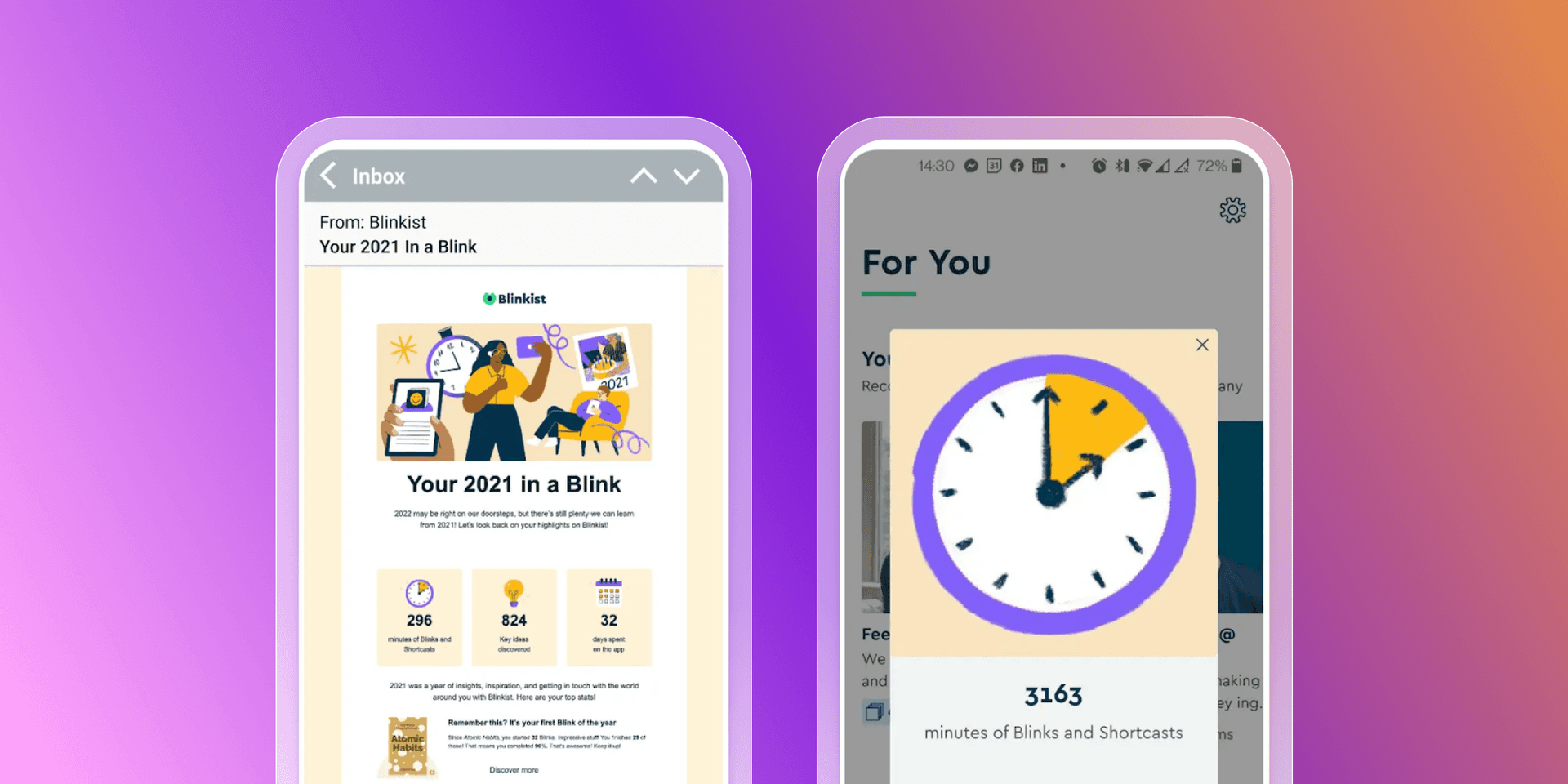
Using behavioral segmentation, Blinkist built a "Year in a Blink" campaign that adapted to each user's level of engagement. Rather than sending a single broadcast message, every segment received content calibrated to where they were, from richly personalized activity recaps for highly engaged users, to motivational content and curated titles for those who had drifted.
The results
- 15% increase in re-engagement compared to the control group
- 76% of users who received the campaign were still engaging a week later
Tonies turns free play into paid conversions—and the numbers are music to their ears
Tonies makes the Toniebox, a screen-free audio speaker for children that plays stories, songs, and audio content through collectible figurines. Beloved by kids and parents alike, the platform sees children averaging 268 minutes of playtime per week, with families typically building a collection of around 20 Tonies over 4.5 years.
The problem
Tonies needed to move users through a defined and orchestrated journey—from new Toniebox owner to active app user, and from free content engagement to paid purchases. Their legacy system lacked the segmentation and cross-channel capabilities to make that happen with any precision, leaving conversion performance flat.
The solution
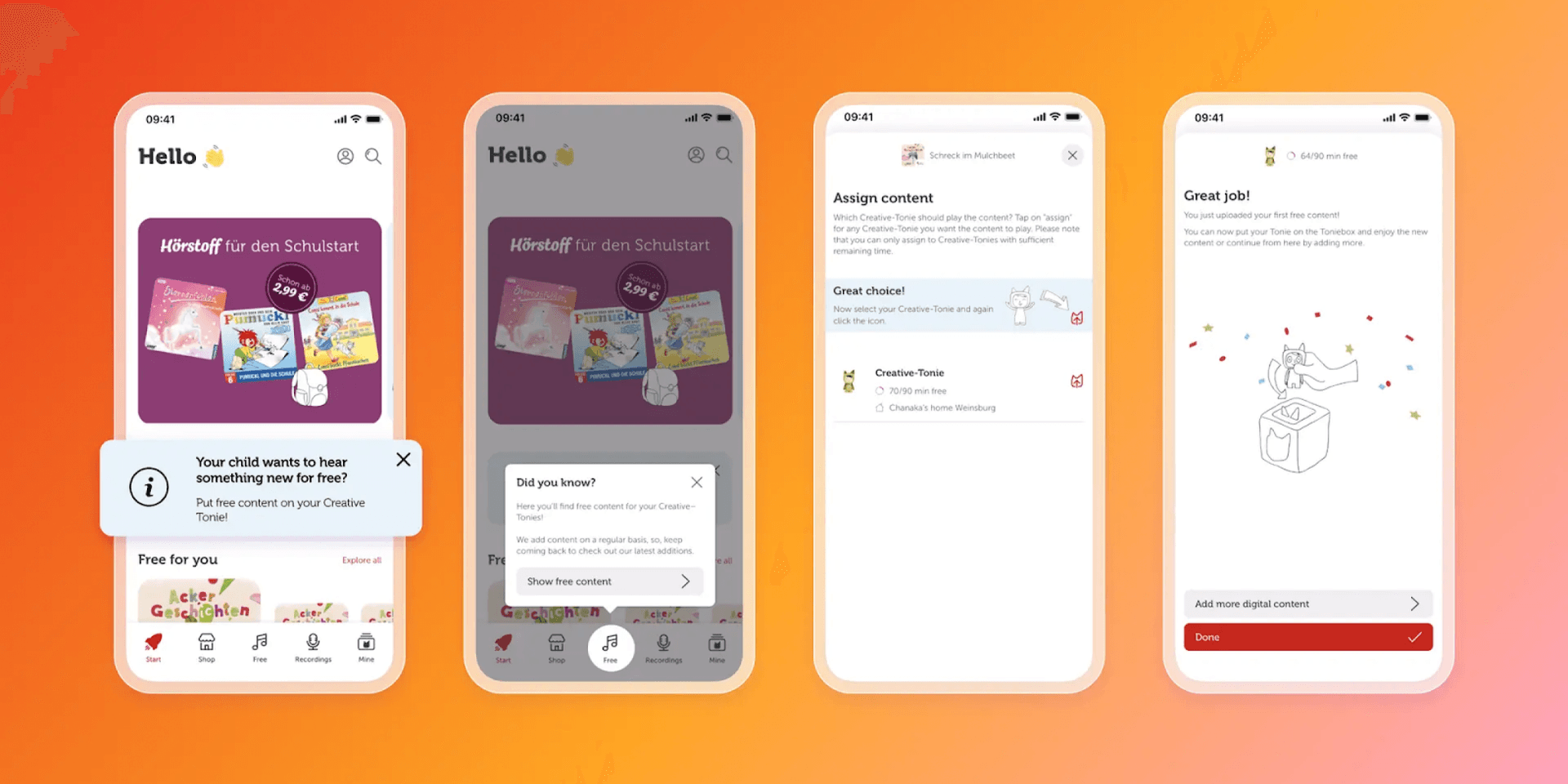
Tonies rebuilt their onboarding and upsell flows using a coordinated mix of in-app messages, Content Cards, and push notifications, each triggered by real-time user behavior. Channel selection at every step was driven by where the user was most likely to engage—inside the app or out of it.
The results
- 117% year-over-year increase in free-to-paid content conversions from 2023 to 2024
Panera keeps guests at the table through its menu shake-up
Panera Bread is a leading fast-casual restaurant chain with more than 2,200 locations across North America, known for its soups, salads, sandwiches, and baked goods. Guest loyalty and personalized experience sit at the heart of the brand's engagement strategy.
The problem
In April 2024, Panera launched the largest menu transformation in its history—more than 20 updates including nine new items. A change that significant carried real retention risk, particularly for loyal guests whose favorites were being altered, and lapsed guests who might not return without a compelling reason to try something new.
The solution
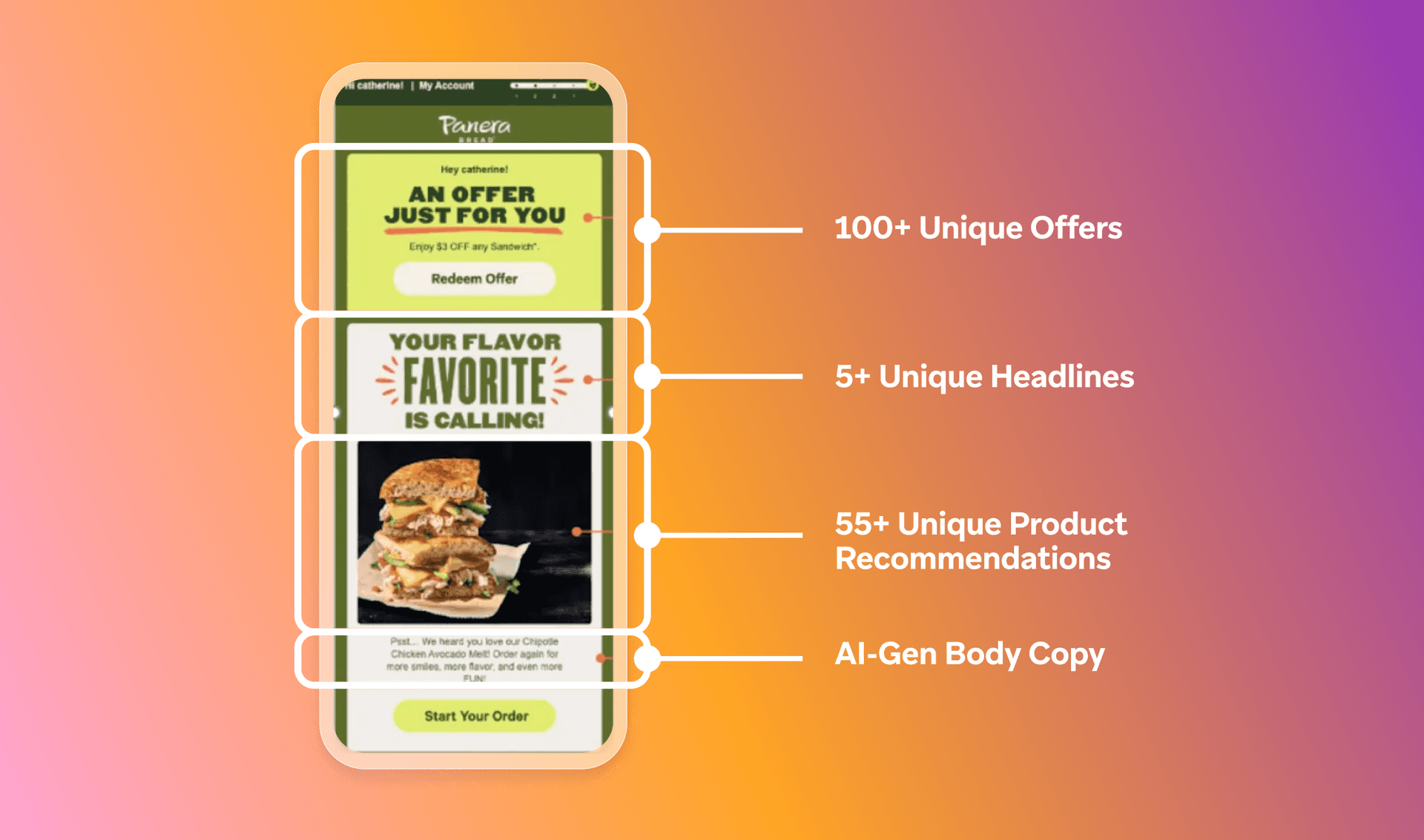
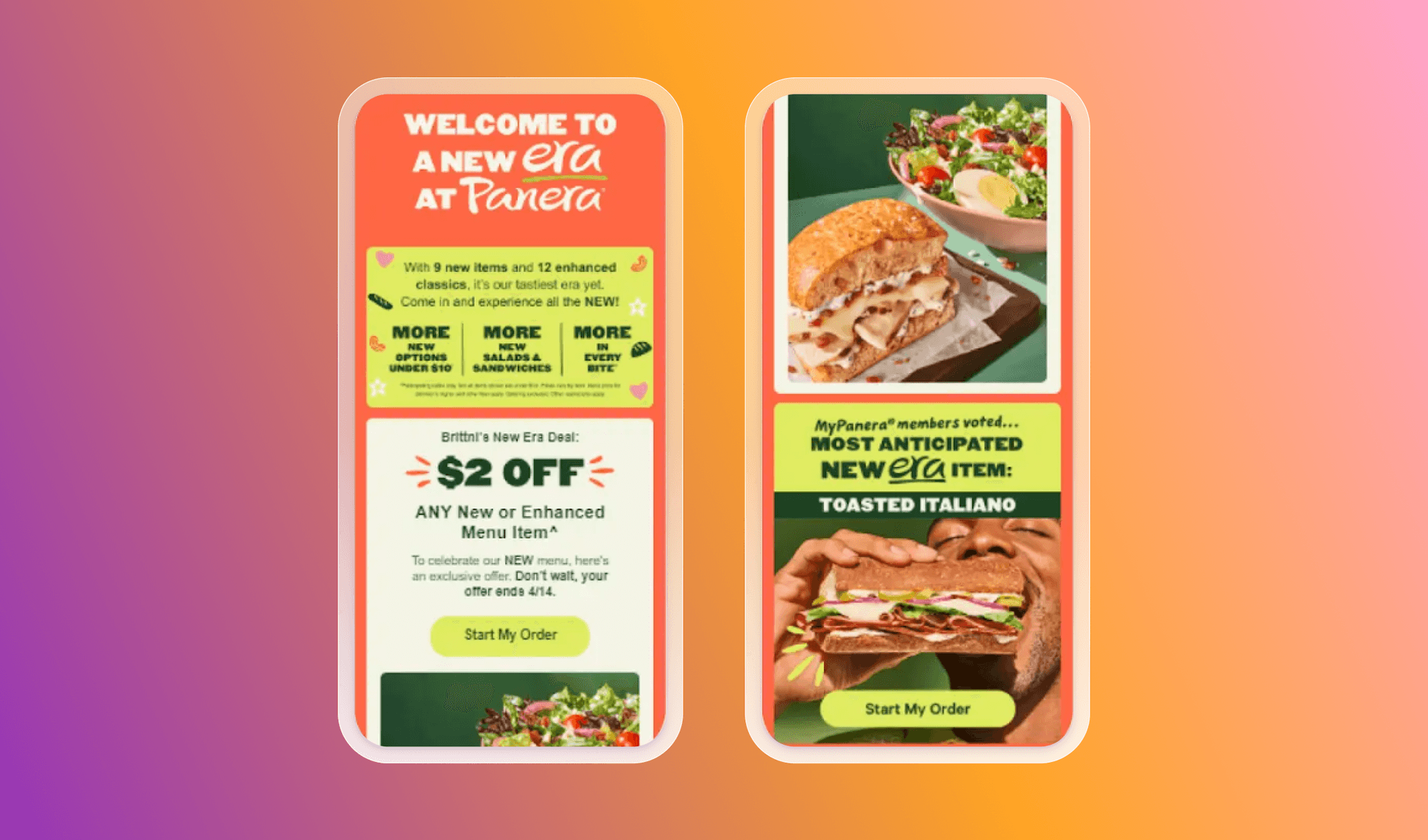
Panera orchestrated a coordinated campaign across email, push notifications, in-app messages, and Content Cards, with over 4,000 unique combinations of personalized offers and recommendations. Every channel played a specific role in moving guests from awareness to action, with AI-powered segmentation identifying those most at risk of lapsing and triggering follow-up messaging for guests who browsed new menu items but didn't purchase.
The results
- 5% retention lift among at-risk guests
- 2X loyalty offer redemptions
- 2X purchase conversions from abandoned order follow-ups
- 50+ hours of manual work saved through automated content creation
Data management for cross-channel campaigns
Every decision a cross-channel strategy makes depends on data. The foundation starts with first-party data, collected through your own platforms via behavior like purchases, app activity, and email engagement, and zero-party data—preferences and intentions customers share with you directly through surveys or preference centers. Together they build an accurate, responsibly sourced picture of each individual that third-party data simply can't match.
Equally important is how quickly that data can be put to work. Streaming data makes it possible to act on real-time data as behavioral signals happen, so that the next message a customer receives reflects where they are right now. When that real-time data is paired with strong segmentation and event-based triggering, the right message reaches the right person at the right moment in their customer journey. And when brands test across channel combinations, timing, and sequences rather than within individual channels in isolation, the strategy compounds through better orchestration—getting sharper and more effective over time.
Related Tags
Be Absolutely Engaging.™
Sign up for regular updates from Braze.
Related Content
View the Blog
Unlocking complete customer intelligence with Snowflake and Braze

Sahiz Kaur
AI for financial services: balancing outcomes and governance

Brandon Liu

From Account Executive to Sales Manager: John Murphy on Building a Career at Braze