Gamification marketing: How to drive engagement, loyalty, and retention
Published on April 28, 2026/Last edited on April 28, 2026/15 min read
Team Braze
Adults are exposed to as many as 5,000 advertising messages every day. Most of them pass by without registering.
What makes some brands cut through? Often, it comes down to whether a customer has a reason to participate rather than just receive. Like a challenge they're halfway through or the promise of a reward. Maybe a status they've earned and want to keep, (LinkedIn Top Voice badge anyone?) These things change the nature of the interaction entirely, and they change what a customer does next.
Gamification marketing takes the special sauce that makes games hard to put down and applies it to the customer experience. Progress, feedback, competition, and reward. A purchase then becomes a step toward a goal. A loyalty program becomes something worth protecting. And a quiz becomes a way for a customer to tell you exactly what they want, on their own terms.
The most effective gamification programs do more than add point systems to purchases though. They use behavioral data and AI-driven triggers to personalize challenges and rewards to each individual. When running coherently across every channel a customer uses, this creates an emotional investment. One that improves retention rates, conversion rates, and customer lifetime value.
TL;DR
- Gamification marketing applies game mechanics (points, badges, leaderboards, challenges, and rewards) to brand experiences to drive engagement, loyalty, and repeat behavior
- The most effective programs combine several gamifications, including loyalty points, challenges, badges, and progress tracking, built around what their specific customers actually care about
- Gamification produces measurable benefits across engagement, retention, conversion rates, and customer lifetime value, and gives brands a privacy-compliant way to collect zero-party data
- AI-driven personalization and behavioral triggers allow brands to adapt gamified experiences to individual customers in real time, increasing relevance and reducing wasted incentive spend
- Cross-channel gamification, where progress and rewards remain consistent across email, in-app, push, and web, produces the strongest long-term results
- Brands like Snoonu, Dutch Bros, and e.l.f. Beauty have used gamification to drive results ranging from 39% order increases to 66x higher engagement
Key takeaways
- Gamification programs are most powerful when built on connected, real-time customer data, so progress, rewards, and recognition are visible and consistent across every touchpoint
- Interactive experiences such as quizzes and challenges generate zero-party data that customers willingly provide, giving brands more reliable personalization signals than passive behavioral tracking
- Behavioral triggers respond automatically to specific customer actions or inactions, and that responsiveness is what makes gamified programs feel personal rather than pre-scripted
- Predictive analytics can identify customers who are losing interest before they fully disengage, giving brands time to step in with a timely challenge or reward
- Gamification applies across the full customer lifecycle, from onboarding through post-purchase retention, and is most effective when each touchpoint builds on the last
What is gamification marketing?
Gamification marketing is when a brand applies game design elements (points, badges, leaderboards, challenges, and rewards) to non-gaming contexts to drive customer engagement, loyalty, and repeat behavior. It turns brand interactions from passive moments into active ones, where the customer has something to work toward, earn, or compete for.
Traditional marketing delivers a message and waits for a response. Gamification creates a loop. A customer takes an action, receives feedback, and is motivated to take the next one. A customer who is 200 points away from a reward tier, or halfway through a week-long challenge, has a self-directed reason to come back.
People are motivated by goals, feedback, and rewards, not just when the reward arrives, but in anticipation of it. The closer someone gets to a goal, the harder they work to reach it. In one study for example, participants in a real café reward program bought coffee more often, the closer they got to earning a free coffee.
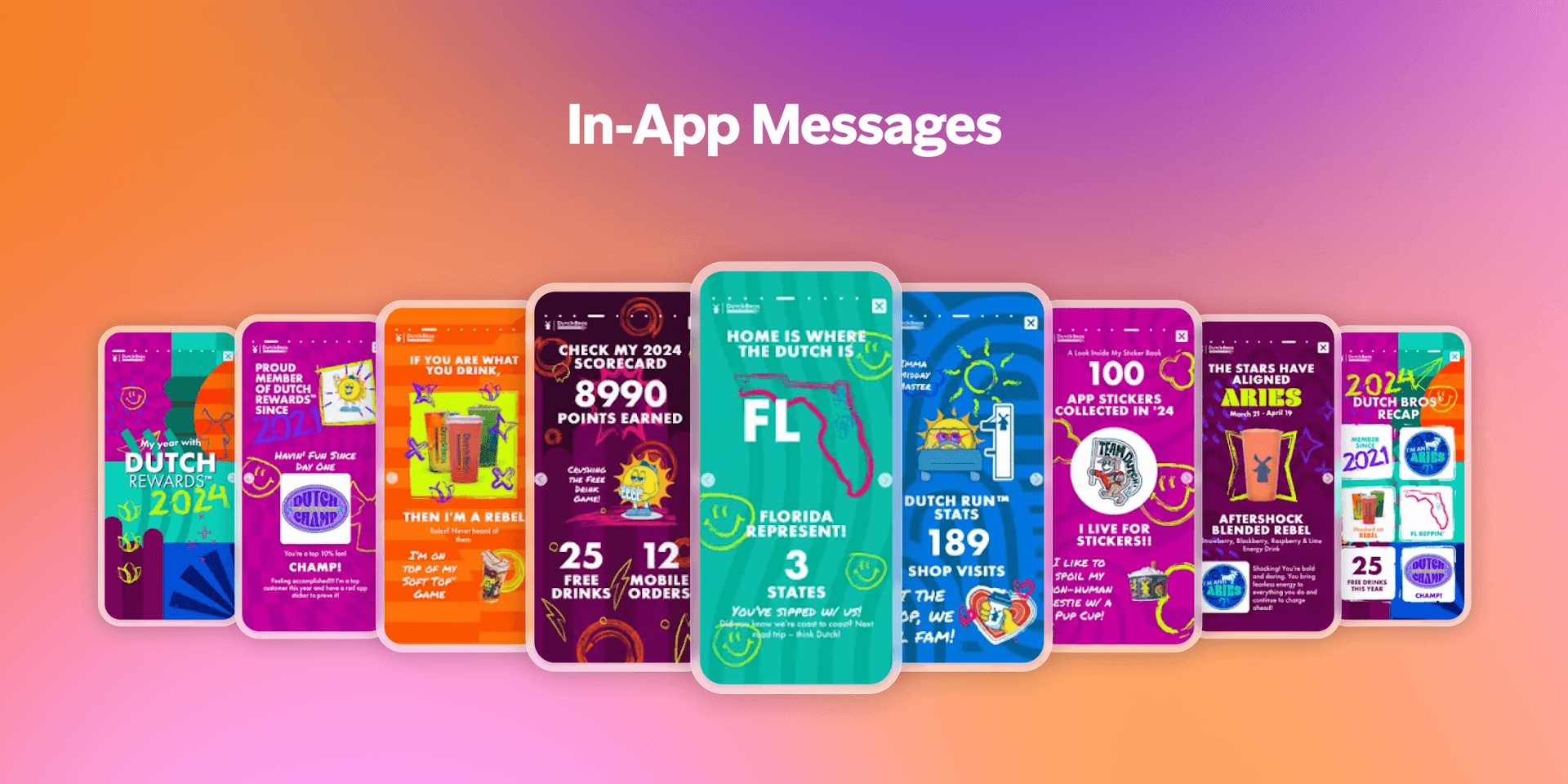
When Dutch Bros coffee company rebuilt their annual customer recap as a personalized, gamified in-app experience, engagement jumped 66 times higher than the email-only version it replaced, with four times the reach.
Gamification applied to a real customer moment produce a fundamentally different level of participation than static content alone.
Key gamification elements in marketing
Points, badges, challenges, progress bars, and leaderboards each drive customer interaction in different ways. Many brands combine several of them, built around what their specific customers actually care about and how they behave.
Loyalty programs, points, and rewards
A points system gives customers something to accumulate with every transaction, and visible progress is a real motivation to return. Layering in a sense of urgency and variety alongside these basics up the stakes for customers.
A multiplier event, for example, a discount day each week, gives customers a reason to visit on say, a Tuesday, when they otherwise wouldn't.
Expiring rewards add a deadline, so customers need to use it or lose it.
Bonuses for non-purchase behaviors (a referral, for example, or completing a profile) keep the program active between transactions and rewards for loyalty.
Tiered structures add a different kind of motivation. Customers who've reached a higher status have something worth protecting, and that instinct drives remarkably consistent behavior.
Badges, leaderboards, and status tracking
Badges and leaderboards bring in the social and competitive side of gamification, and for a lot of customers, these are more motivating than financial rewards.
A badge earned for a first purchase or a successful referral marks a specific moment in a customer's history with your brand. Customers notice when a brand notices them.
Leaderboards add peer comparison to that mix. Knowing a friend holds a higher ranking creates a pull that's hard to ignore, particularly for brands with active communities where a bit of friendly competition feels completely natural.
The more specific the recognition, the better it lands. A badge that says "You've visited these five specific shops" means more than a generic, “You’ve visited us!”
Interactive experiences and games
Interactive experiences give customers something to do rather than something to look at. Spin-to-win, product finders, and in-app games create moments of genuine participation that static content can't replicate.
They also generate data that customers share willingly in the moment, which makes every subsequent interaction easier to personalize.
Challenges and quizzes
When a customer completes a quiz to find their best-fit product, they're sharing preferences directly and willingly. Zero-party data collection is more reliable than behavioral inference and more privacy-compliant than passive tracking. For brands navigating an increasingly privacy-conscious landscape, it's also a much more honest exchange.
Challenges work differently but just as well. A five-day challenge with a clear reward, for example, creates structured return visits and a sense of shared participation that tends to reinforce itself. Customers can see others taking part, which brings a sense of community to their participation.
Achievement and progress tracking
Showing a customer how close they are to a goal directly motivates them to reach it. An onboarding checklist, a loyalty dashboard, a progress bar or a challenge tracker updating after each qualifying purchase. Each one turns a process into a goal, and a goal into a reason to come back.
Benefits of gamification marketing
Gamification and immersive marketing, can aid growth plans, and improve metrics across the board. It does this by changing the nature of the relationship rather than just the frequency of contact. Here's where brands typically see the benefits show up:
Higher customer engagement and time spent with your brand
A customer tracking progress toward a reward, working through a challenge, or checking a leaderboard has a self-directed reason to open your app or email. The brand becomes part of a routine rather than an interruption and every bit of customer engagement helps with campaign optimization.
Stronger loyalty and repeat behavior
A customer with an emotional stake in a program (a badge collection, a tier worth protecting, a challenge almost complete) is less likely to be swayed by a competitor's promotion. The motivation runs deeper than price.
Zero-party data you can actually use
Quizzes, preference surveys, and interactive profiles generate data customers share willingly. It's more accurate than behavioral inference and far easier to act on for personalization.
Better conversion rates across channels
Add interactive elements to a static email and customers have a reason to engage rather than just read and move on. It makes customers purposeful rather than passive.
Social sharing you didn't have to ask for
Leaderboard positions, badge collections, and year-in-review moments give customers something worth posting. Dutch Bros saw exactly this when customers voluntarily shared their Dutch Rundown personas across social media.
A longer customer lifecycle
A customer working toward a reward or tier upgrade is not thinking about their next purchase in isolation. The mechanics create forward momentum that extends the relationship well beyond any single campaign.
Improved retention strategies.
Retention depends on customers finding reasons to return before they drift. Gamification builds those reasons into the experience itself, through streaks, tiers, and ongoing challenges that create habitual return behavior.
Implementing AI-driven personalization in gamified campaigns
Gamification programs that treat every customer the same (same challenge, same reward, same timing) leave a lot on the table. The more the experience reflects how each individual actually behaves, the more likely it is to build a habit rather than be ignored.
Most personalization in gamification starts with behavioral triggers and rules. A customer reaches a tier and gets a notification. A challenge expires and a reminder goes out. These automated responses are useful, and for loyalty-heavy categories like QSR, where personalized gamification is already reshaping how brands retain customers, they form the foundation of any effective program.
But there is a more powerful layer beyond rule-based automation. AI decisioning moves past segments and predefined logic entirely. Rather than following rules, it continuously learns from individual customer behavior to determine the best challenge, reward, channel, timing, and frequency for each person simultaneously, optimizing for the business outcomes that actually matter rather than surface metrics like opens and clicks.
Personalizing challenges and rewards based on behavior
A customer who makes frequent lunchtime purchases gets a challenge built around that pattern. One who browses regularly but rarely converts gets an offer calibrated to drive that first action. The same logic applies to rewards. Customers are motivated by different things, and AI models trained on behavioral data can identify which reward type is most likely to prompt action for each person, reducing incentive spend while improving outcomes.
In industries where more than 82% of brands already run a loyalty program, personalization is often the only real differentiator remaining.
Behavioral triggers and dynamic content in gamified campaigns
Behavioral triggers turn a gamified program from something that runs on a schedule into something that responds to what customers are actually doing. A customer who reaches a new loyalty tier gets a celebratory push notification. One who hasn't opened the app in 10 days gets a message showing exactly how close they are to their next reward. One who completes a challenge gets an immediate confirmation and a preview of what comes next.
Each of those moments is specific to that customer at that moment, and that specificity is what makes them relevant enough to spark engagement.
Using predictive insights to optimize participation and engagement
Fewer app opens, shorter sessions, skipped challenges — these are early signals that a customer is losing interest. AI models can spot these patterns and recommend an intervention, whether that's a new challenge, a surprise reward, or a well-timed recognition moment.
Predictive timing helps too. Delivering a challenge notification when a customer is most likely to engage, based on their own historical behavior, consistently produces better participation rates than sending at a fixed time. Over the course of a program, those marginal gains add up.
Gamification across channels
A gamified experience that lives in a single channel captures only a fraction of what it could deliver. The strongest programs follow the customer wherever they are, keeping progress, recognition, and rewards consistent throughout.
Email, in-app messages, push notifications, and web interactions
Each channel plays a different role:
- Email suits milestone moments. A reward earned, a tier reached, a challenge summary, or a preview of what's coming next
- In-app messages and Content Cards are where gamification feels most native. Customers are already in your space, so challenges, progress dashboards, and badge displays belong here
- Push notifications work best as timely nudges. A challenge about to expire, a leaderboard position that's slipped, a reward ready to claim
- Web is where gamified elements like interactive quizzes, personalized product finders, and spin-to-win games can move a customer from discovery to decision in a single session
Coordinating gamified experiences for cross-channel consistency
A badge earned in-app should appear in an email summary. A challenge introduced via push should be completable on the website. Points earned anywhere should update everywhere, in real time.
Without a unified customer profile that updates as customers interact, gamification becomes fragmented. A customer who sees their progress in one place but not another starts to question whether the program is reliable, and that friction can kill engagement.
Enhancing engagement at every stage of the customer journey
Customer journey gamification earns its place across the full customer lifecycle, not just at the point of purchase. Designing when and where gamification is used should be done with full oversight of the customer journey. The possibilities are endless, but it could look something like this:
- Onboarding: a progress checklist turns account setup into an active goal
- Consideration: an interactive quiz personalizes the outcome and moves the decision forward
- Purchase: a points multiplier or limited-time challenge adds urgency
- Post-purchase: a challenge that rewards repeat behavior sets up the next visit before the current one has ended
Gamification marketing in action
The following examples show gamification applied to three very different problems, in three different industries. In each case the decision to make the experience participatory rather than passive is what drove the results.
1. Snoonu spins the wheel and lands on 39% more orders
Snoonu is one of Qatar's fastest-growing tech companies, offering eCommerce, on-demand delivery, and smart services across multiple verticals. Their branded grocery store, Snoomart, sits at the heart of their ambition to become a daily-use platform for customers across the region.
The challenge
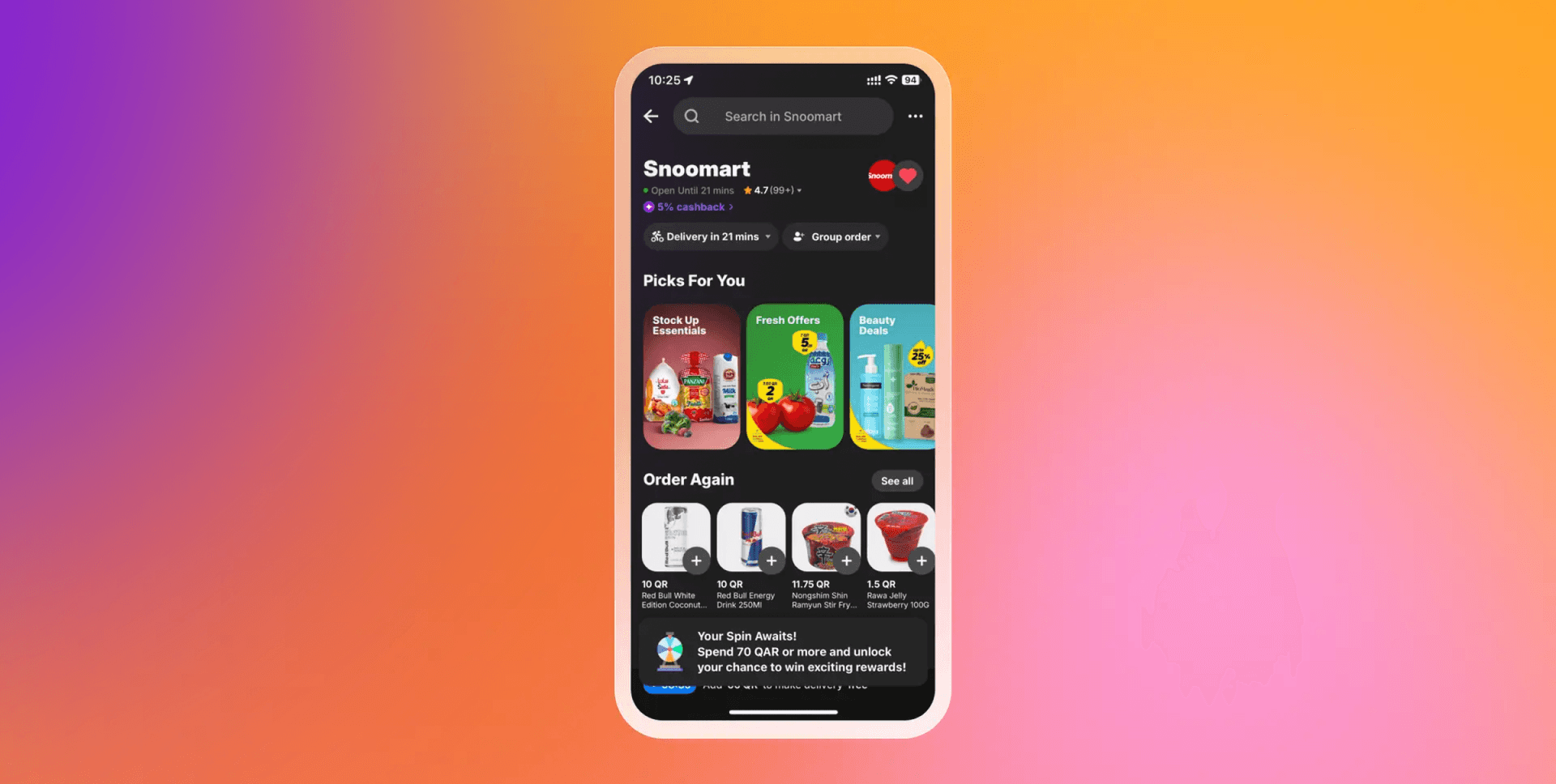
Snoonu wanted to drive repeat orders and deeper engagement within Snoomart, without the development resources for a complex build. They needed something that could move fast and still deliver a genuinely engaging experience.
The strategy
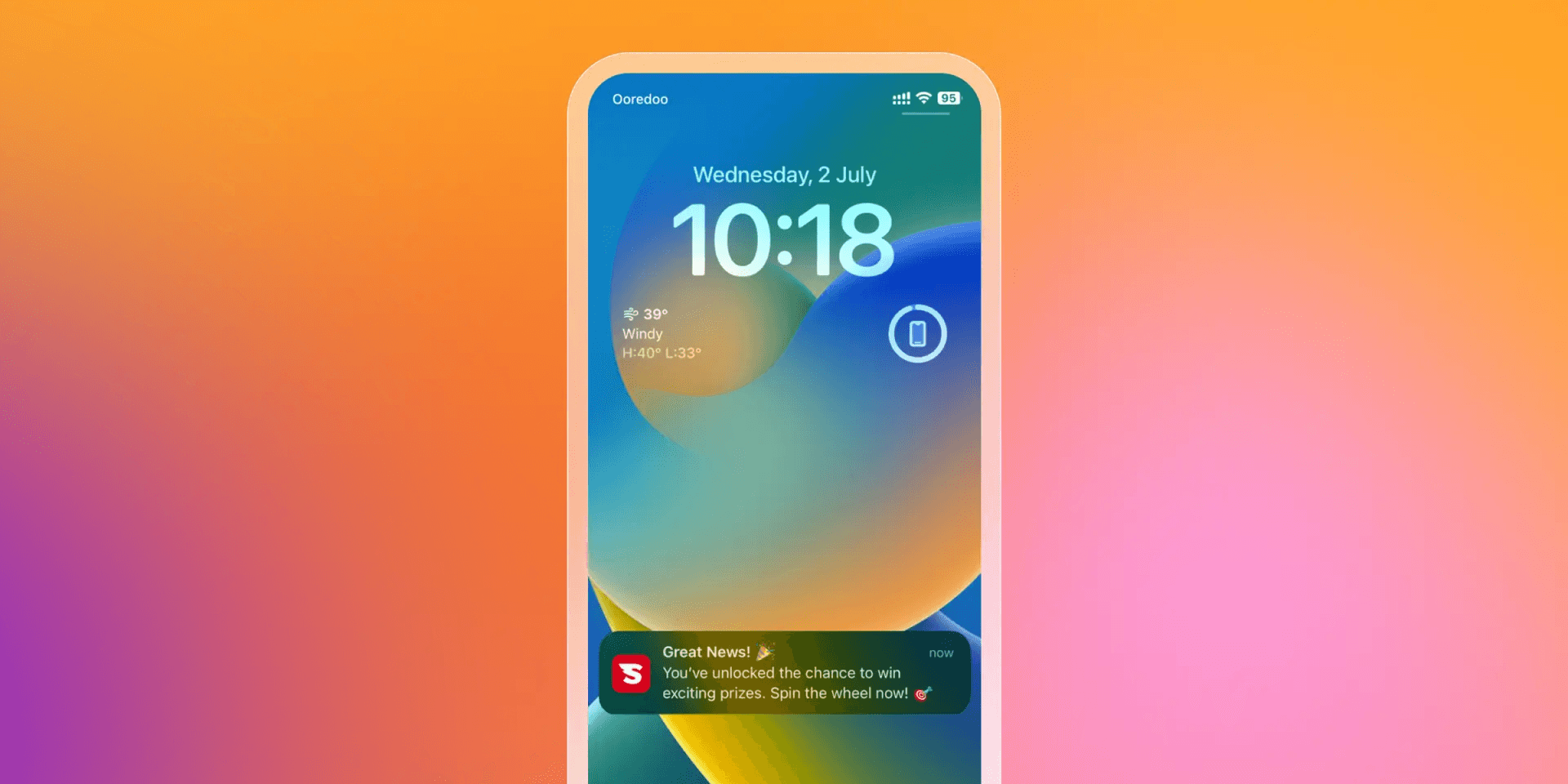
Snoonu launched a "Spin the Wheel" campaign in 30 days. Customers who placed a Snoomart order above a set threshold were shown a prompt in the app introducing the mechanic. Once their order was delivered, a push notification invited them back to claim their spin. The wheel ran inside the app, with rewards assigned automatically to each customer's account and a promo code delivered instantly on screen.
The wins
- 39% increase in orders
- 32% increase in revenue
- 30% increase in brand page visits
- All results benchmarked against Ramadan, Snoomart's traditional peak period, making the incremental gains even more notable
2. Dutch Bros stirs up a 66x engagement win with a gamified year-end
Dutch Bros is a community-driven drive-thru coffee brand with over 1,000 locations across the U.S., built around genuine connection and a fiercely loyal customer base.
The challenge
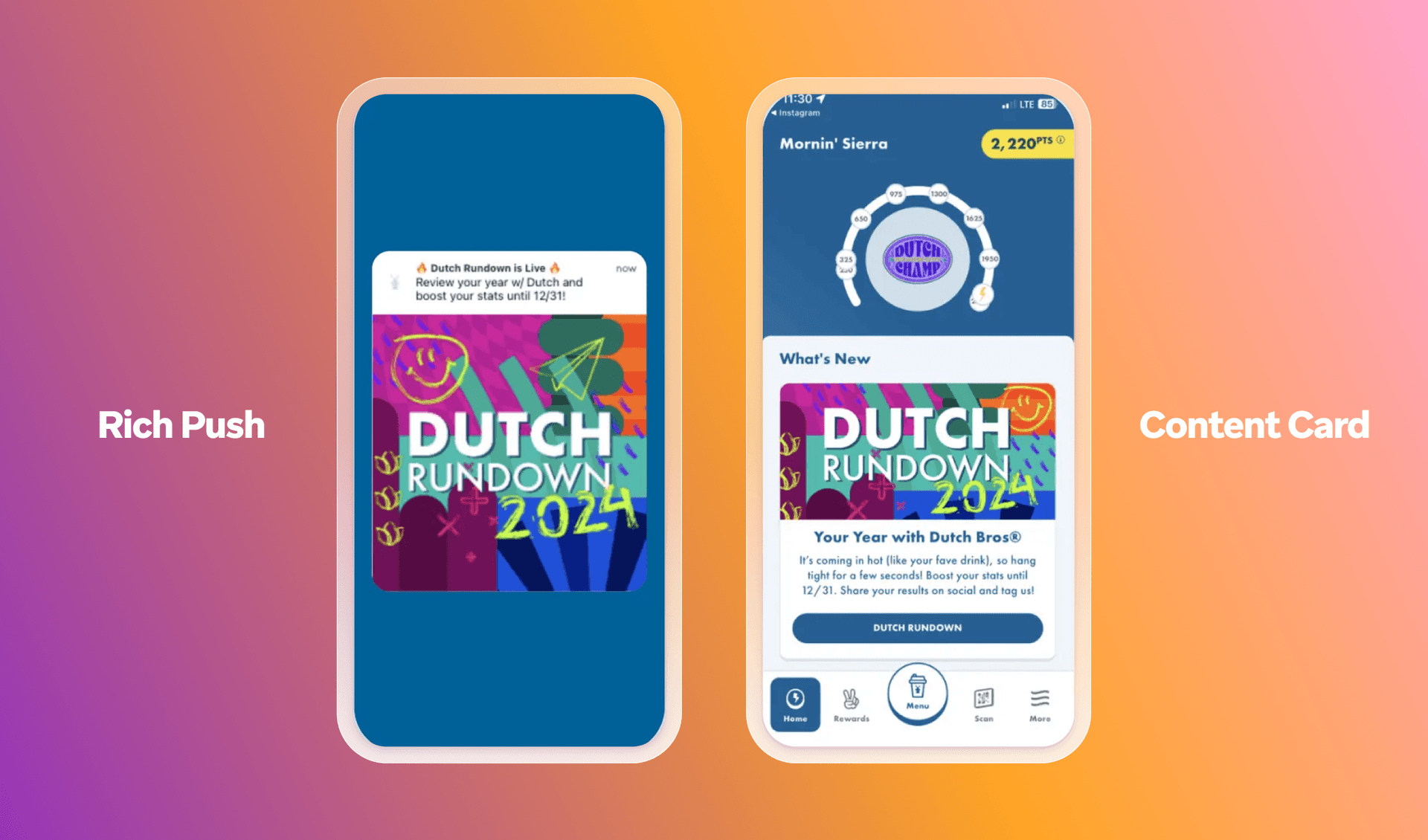
The Dutch Rundown™, the brand's annual year-end customer recap, had become a fan favorite. But it only reached email subscribers, excluding a significant portion of the loyalty base. The format also offered little room for real interaction. A beloved moment was reaching far fewer people than it should have.
The strategy
In 2024, Dutch Bros rebuilt the Dutch Rundown™ as an interactive in-app experience, opening it up to all loyalty members regardless of email status. Customers were assigned personas based on their year-long behavior, with categories like "Champions" and "Rookies," each unlocking exclusive in-app stickers.
Full-screen carousels showed personalized stats including points earned, favorite locations, and drink pairings. The data stayed live through December, so customers who kept visiting could watch their numbers update in real time, giving them a direct reason to keep engaging through the holiday season.
The wins
- 66x higher engagement compared to the previous email-only experience
- 4x the reach of 2023, extending the Rundown to all loyalty members
- Strong social sharing as customers posted their personas and sticker collections
- Increased repeat visits through December as customers worked to improve their year-end stats before the program closed
3. e.l.f. finds the beauty in gamification and a 125% jump in app usage
e.l.f. Beauty is a digitally native cosmetics brand that crossed $1 billion in annual net sales in March 2024, with 23 consecutive quarters of net sales growth. Their loyalty program, Beauty Squad, has over 5.3 million members and sits at the center of the brand's digital engagement strategy.
The challenge
e.l.f. wanted to deepen digital engagement, grow loyalty program participation, and bring Beauty Squad members back into the app more regularly. They also wanted to expand into mobile channels they hadn't yet fully activated.
The strategy
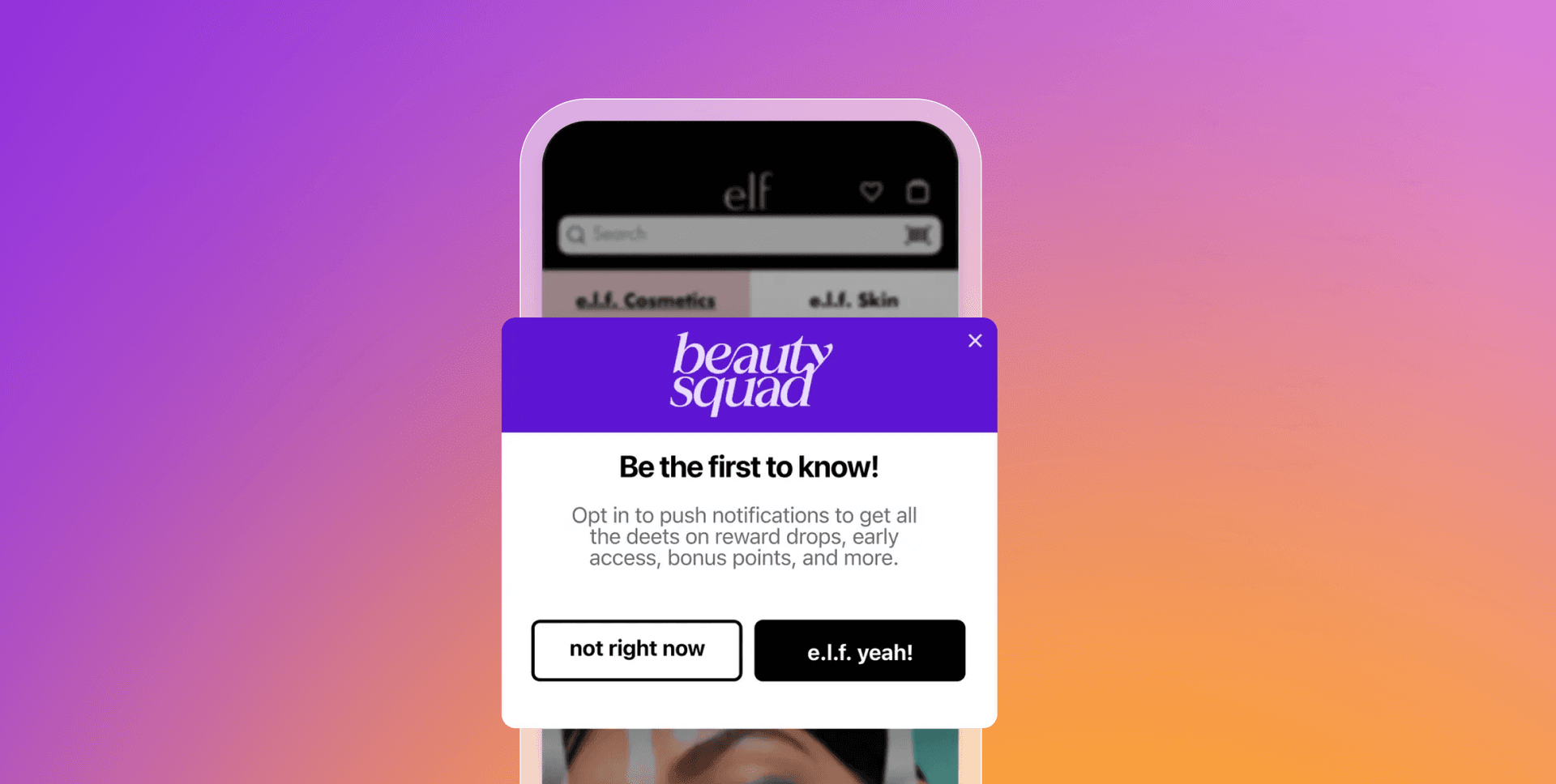
The e.l.f. team built an in-app scavenger hunt using a series of five push notifications to lead Beauty Squad members through the app, with each clue pointing to a page where they could earn points redeemable for products.
This built app familiarity alongside the reward. They followed it with Beauty Squad Replay, a personalized year-in-review campaign that gave each member a 28-screen in-app experience unique to their year with the brand, followed by a Content Card landing page with 21 individual shareable cards. Members could post their cards directly to social media without leaving the app.
The wins
- 125% increase in monthly mobile app usage over six months (March to September 2023)
- 58% year-over-year increase in loyalty offer redemptions (2023 compared to 2024)
- 25% of Beauty Squad Replay participants shared their cards on social media
Final thoughts and takeaways
The clearest sign that a gamification program is working is when customers engage without needing to be reminded. They check their points balance, complete a challenge, or refer a friend because it is worth doing to them, not because a notification prompted it. Getting to that point requires personalization that makes the experience feel genuinely relevant, behavioral responsiveness that rewards the right actions at the right time, and a cross-channel setup that keeps progress consistent wherever customers show up.
Brands that treat gamification marketing as an ongoing, adaptive system (rather than a periodic campaign) tend to see returns compound over time. Customers who engage this month are more likely to engage next month. The process creates the pattern and the data and AI intelligence behind them give each interaction the personal relevance that keeps customers invested.
Be Absolutely Engaging.™
Sign up for regular updates from Braze.