Key insights from Grow with Braze Melbourne 2026
Published on June 02, 2026/Last edited on June 02, 2026/12 min read
Team Braze
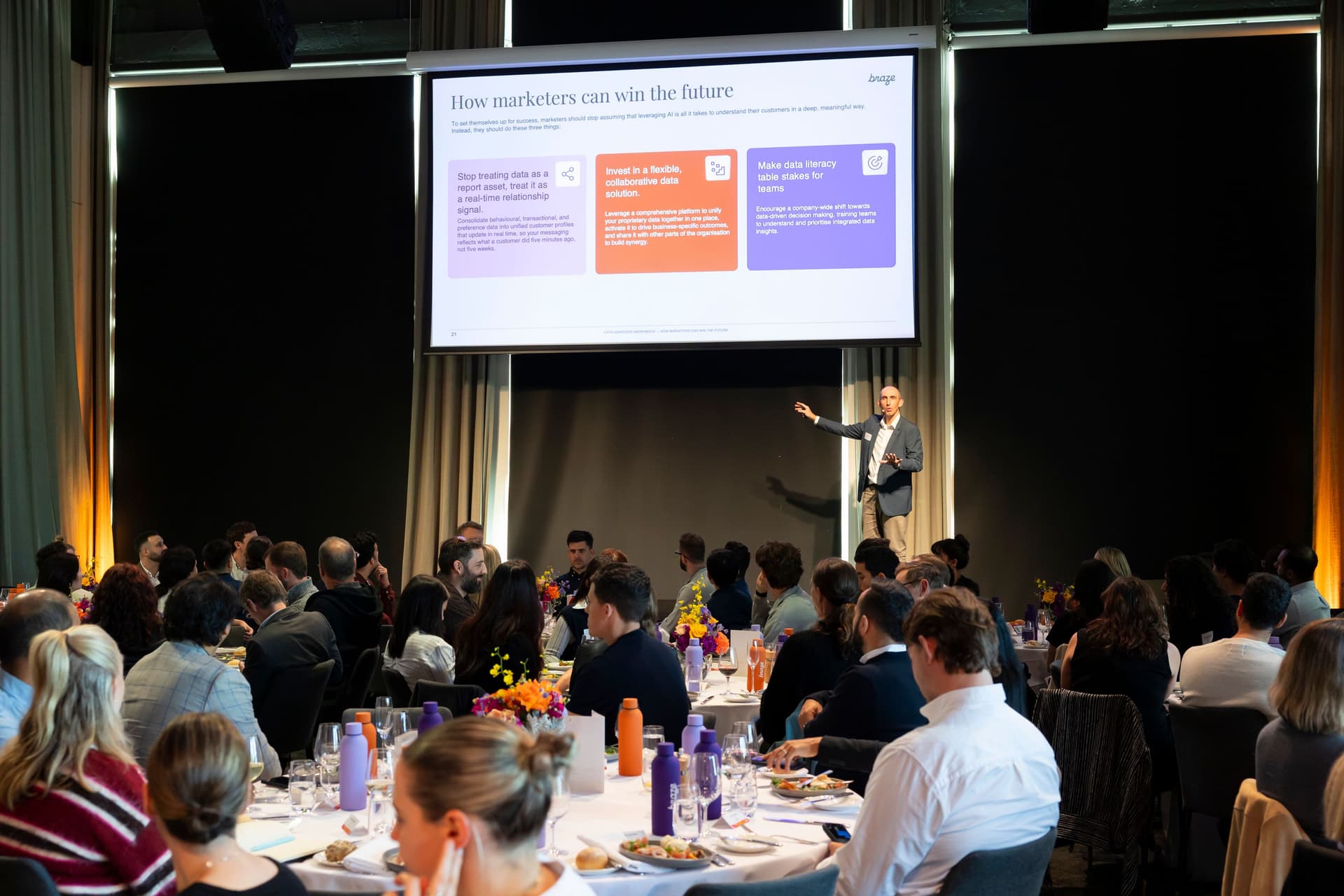
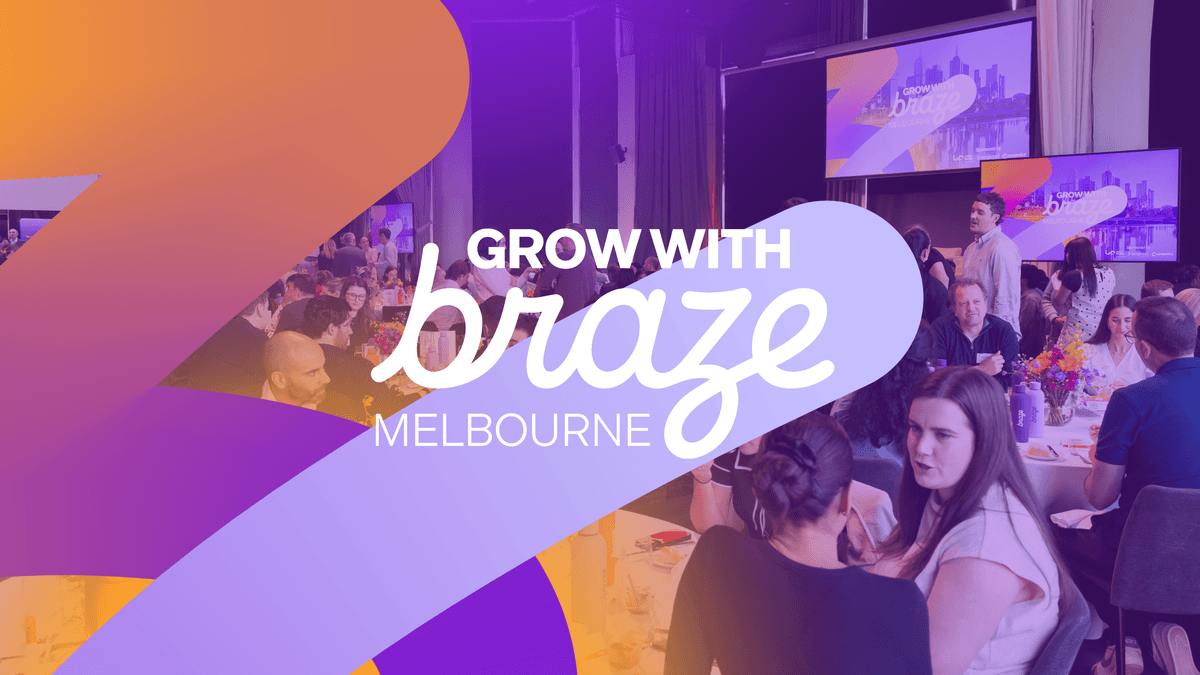
Grow with Braze Melbourne 2026 brought together more than 270 marketers, technologists, and product leaders at Metropolis Events on Southbank on 14 May. Record numbers. Record energy. And a question that hung in the air from the very first slide, in a world where AI agents are beginning to mediate the relationship between brands and their customers, what does it take to stay genuinely connected?
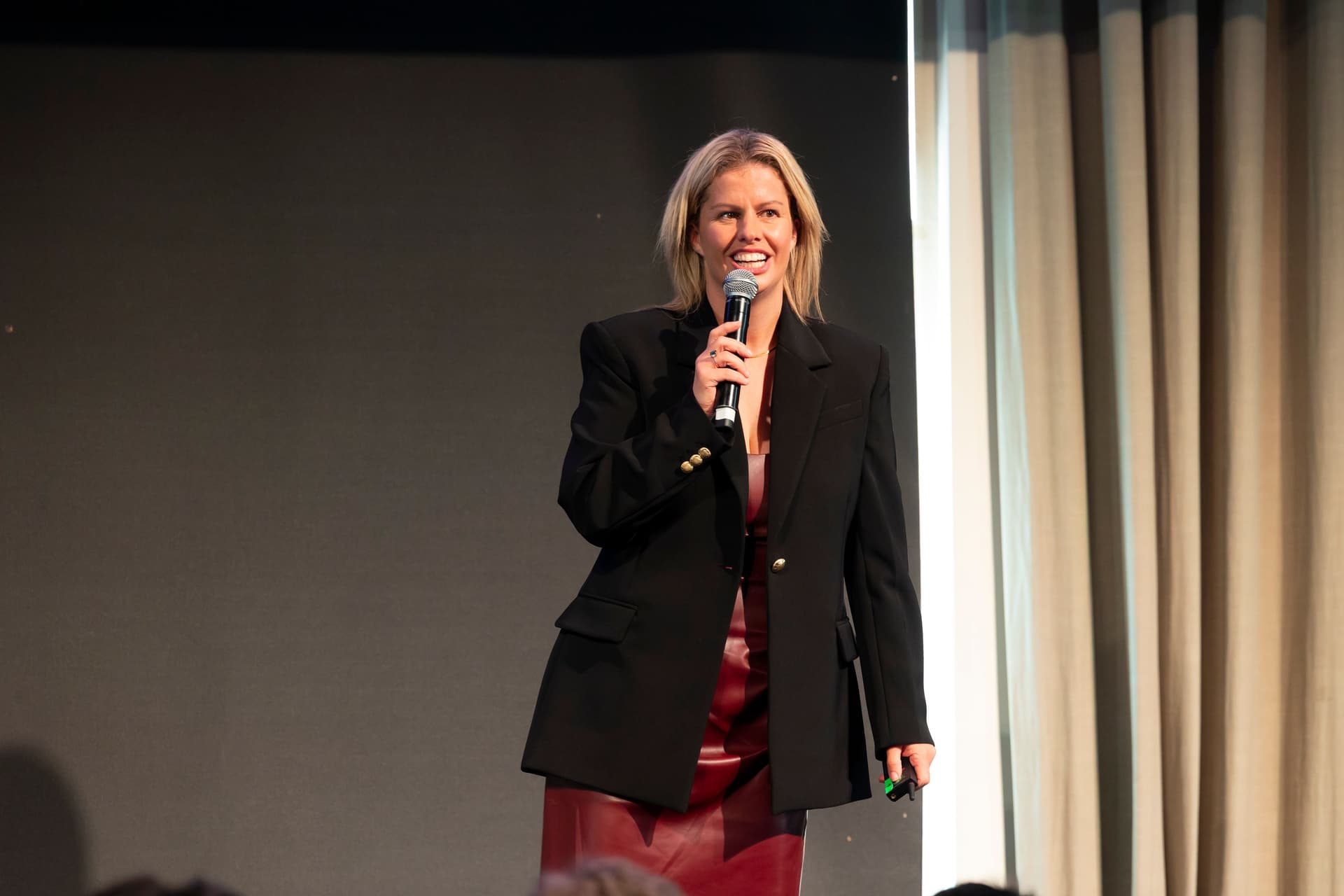
Emma Gray, who leads Braze's Enterprise team in ANZ and hosted the afternoon, framed the challenge simply: The pace of change in customer engagement has never been faster, and the brands thriving right now are not the ones with the most data or the biggest budgets. They are the ones who can act on what they know, at the individual level, in the moment that matters.
That theme, AI as the connection catalyst, ran through every session, every panel contribution, and every customer story shared across the afternoon.
Where ANZ marketing stands right now
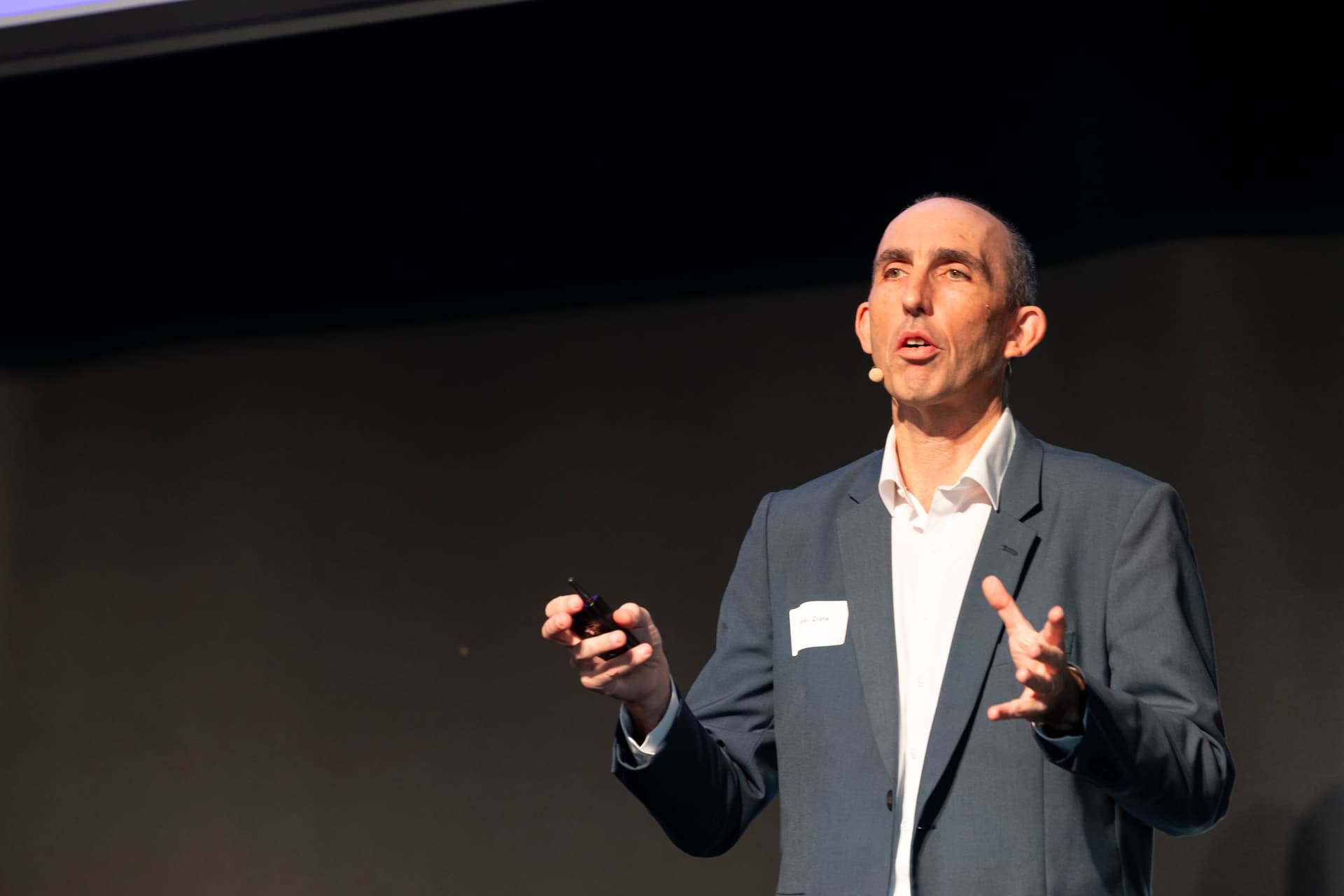
Ashley Crane, Director of Customer Success at Braze, opened the keynote with a number that set the tone: 4.5 trillion messages sent through the Braze platform in 2025. While the audience absorbed that, Ashley pivoted to the more important question. Are those messages actually working?
Drawing on the 2026 Customer Engagement Review, which aggregates survey data from 2,200 marketing executives, 4,000 consumers, and insights from six billion user profiles, Ashley walked through three trends specific to the ANZ market.
The first, which he called 'data hoarders anonymous,' exposed a gap that will be familiar to many in the room. A huge 98% of ANZ marketing leaders say AI helps them understand their customers with greater accuracy than before, the highest of any region globally. Yet only 34% are using real-time data to assemble content for individual users at the moment of engagement. The insight is there. The activation is not. As Ashley put it, the goal is not to know your customer; it is to show them that you know them.
The second trend, 'trust or bust,' addressed the emerging reality of AI intermediation. A notable 68% of ANZ marketing leaders already say AI intermediaries have weakened their ability to maintain direct customer relationships. The counterintuitive response? Do not fight the agents. Instead, build direct brand experiences so compelling that customers choose to engage with you first. Luxury Escapes, a premium ANZ travel brand, offered a sharp example: By deploying the BrazeAI Agent Console to replace static segmentation with a dynamic AI agent evaluating ten distinct behavioral signals, they achieved a 10% uplift in revenue per user without changing a single email.
The third trend, 'the revenue rollercoaster,' captured a uniquely ANZ tension. An impressive 90% of ANZ marketing leaders expect budgets to increase in the next twelve months, the most optimistic outlook of any region globally. Yet only 61% exceeded their revenue goals last year. Budget growth means nothing without the skills and systems to deploy it.
"The brands winning in ANZ are not the ones with the most data. They are the ones who can act on it fastest, at the individual level, in the moments that matter."
● EARNING TRUST, BUILDING LOYALTY
NBL: From fan data to fan relationships
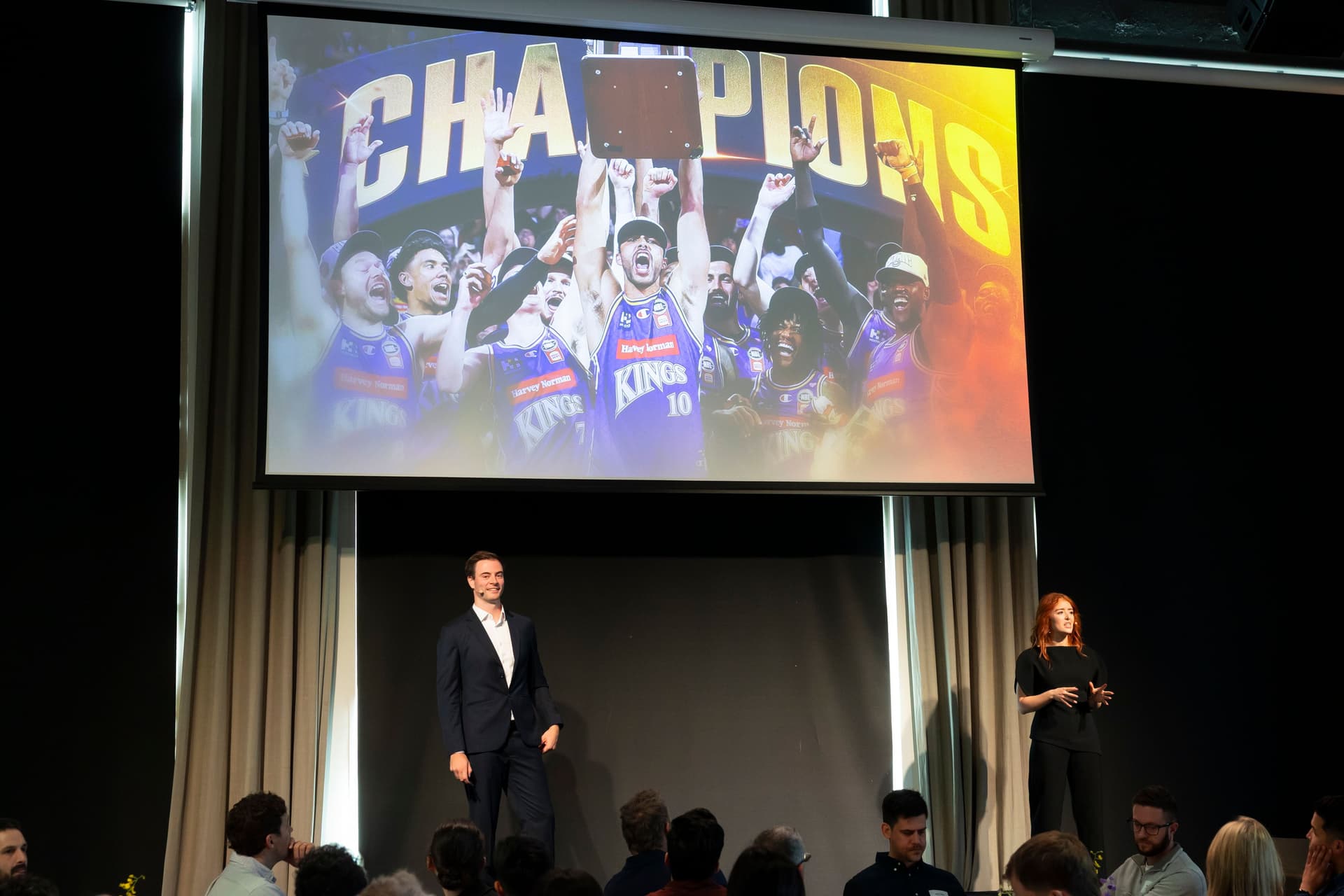
Hayleigh Dickison, Digital Marketing Lead, and Chris Chopping, Fan Data and Analytics Manager, took to the stage to share how the NBL turned its most successful season in history into a story about data discipline, not just sporting performance.
The challenge was structural. The NBL's fan base spans three leagues, multiple clubs, ticketing systems, memberships, merchandise, and digital engagement through NBL+. The data existed. What was missing was a unified view and the activation to match. As Hayleigh put it: They had two million fans who were clearly different from each other, but were still being marketed to as if they were the same.
The team built a unified data layer across the entire ecosystem, feeding an RFM model that identifies champions, loyal high-spenders, promising newcomers, and fans beginning to drift. That single customer view feeds directly into Braze, ensuring every journey is built on a consistent, current picture of each fan. For the NBA x NBL Melbourne series, the team used Braze Audience Sync to build lookalike audiences from their highest-value fans, bringing new, high-intent supporters into tailored Braze journeys.
The real scalability story, however, is what happens next. The same data model, the same segmentation logic, and the same Braze architecture are now rolling out across Melbourne United, the Adelaide 36ers, and the Brisbane Bullets, with clubs operating as child accounts. Build once, scale everywhere.
"When you combine strong data foundations with platforms like Braze, you move from sending campaigns to building real relationships with fans."
● ANTICIPATING NEEDS, ORCHESTRATING JOURNEYS
Panel: Adairs, Live Nation, and Mangrove Digital on orchestration at scale
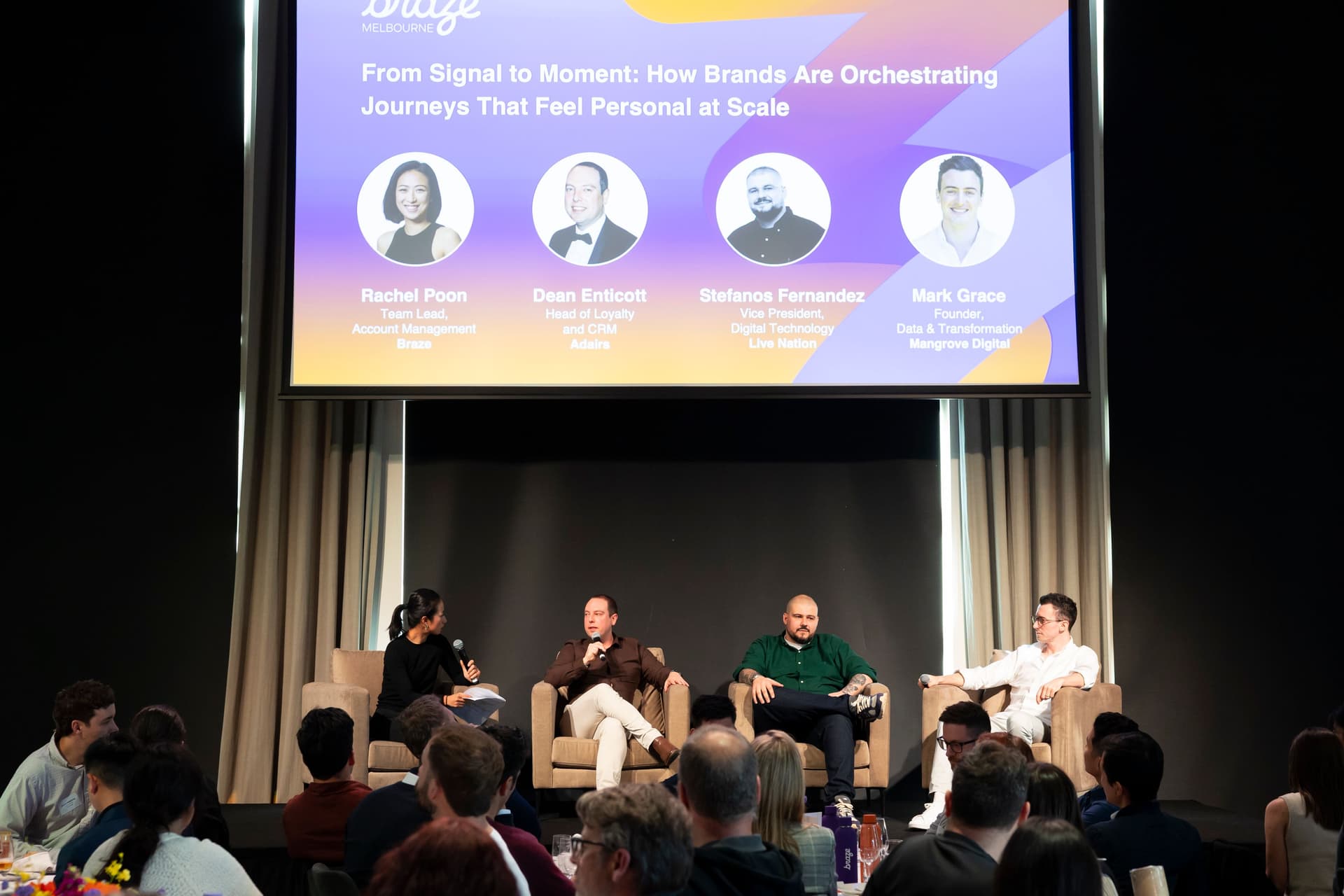
The afternoon's panel, moderated by Rachel Poon, Team Lead, Account Management at Braze, brought together three perspectives on what it actually looks like to orchestrate customer journeys across channels at scale. Dean Enticott from Adairs, Stefanos Fernandez from Live Nation ANZ, and Mark Grace from Mangrove Digital each offered a different lens on the same underlying challenge: being in the right place, at the right time, with the right message, for thousands or millions of people at once.
For Adairs, where the Linen Lovers loyalty program drives 80% of daily sales, the challenge is making infrequent purchase signals work harder. Dean described how the team layers customer profiling and lifestyle information over transactional data to understand not just what a customer bought, but why. A member who purchased from the kids category once is treated very differently from one identified as a family with young children. Across the last twelve months, Adairs has run more than 60 A/B tests in Braze, using the results not just to improve open rates, but to decide which moments deserve a dedicated lifecycle journey versus a one-off send.
"Start small, learn fast, scale up. With so much customer information in Braze, we can find the best test segment and remove the risk of personalization missteps before we go to the larger base."
Live Nation's Stefanos Fernandez described an approach built around the idea that fan behavior is a live signal, not a retrospective report. The strongest predictive signals are moments of clear intent: a fan viewing an artist page around a tour announcement, opting into a presale reminder, registering for a Live Nation membership. The team now uses Braze Audience Sync for real-time suppression when a purchase is made, so a fan who converts does not receive a 'don't miss out' message they no longer need. The sequencing, from email to in-app to SMS to paid social, is designed so each channel has a specific role. The result is a journey that feels like fan service, not a marketing push.
Mark Grace from Mangrove Digital offered the practitioner's view across brands at different stages of data maturity, reinforcing that the biggest gaps rarely come down to tooling. Brands with Braze have the infrastructure. The harder work is cultural: building the habits of telemetry-driven decision-making and creating the organizational muscle to act on signals before they go stale.
● HUMANISING CONVERSATIONS, PROVING IMPACT
Canva: Three campaigns that prove intent is everything
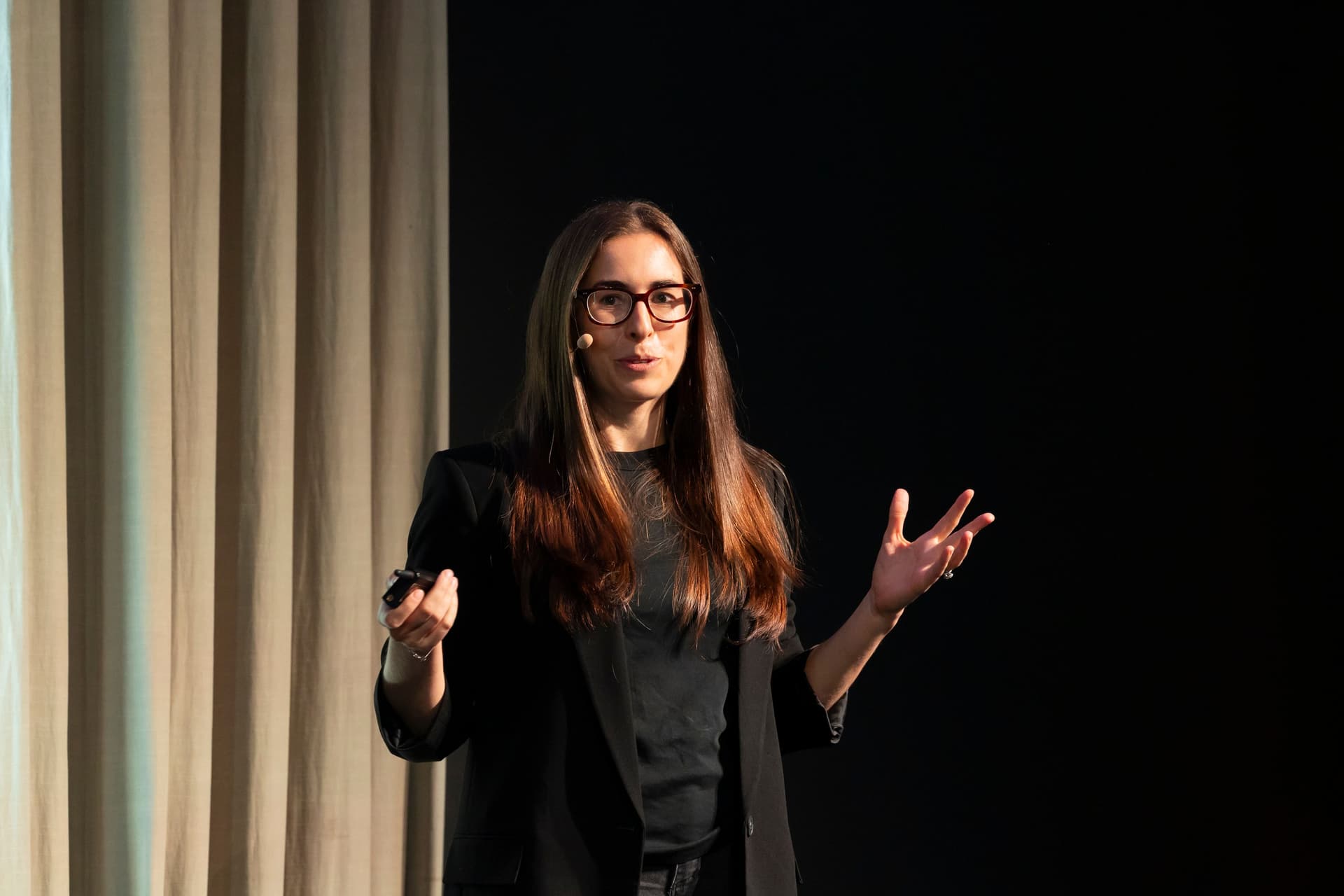
Jess Baden, Lifecycle Marketing Lead at Canva, opened with a framing borrowed from Braze CEO Bill Magnuson: the AI challenge is not output, it is outcomes. Volume does not equal value. At Canva's scale, serving customers across more than 190 countries with over 400 designs created every second, the temptation to send more is constant. What actually earns attention is relevance at the individual level.
Jess walked through three campaigns that trace a journey from intent to activation to long-term retention.
The first centred on enterprise intent signals. Canva's Contact Sales CTA appears dynamically in email headers for eligible enterprise audiences based on lead score and role. But when prospects clicked through, significant drop-off followed. The solution was link aliasing: Tagging the CTA link with a named alias and using it to trigger a Canvas the moment someone clicks. A one-hour delay checks whether the form was completed. If not, a follow-up email lands, introducing Canva Enterprise properly and offering a demo. Using Braze's Catalog and Liquid personalization, the email even directs the prospect to a custom landing page built around their company. The result was more than 150,000 users retargeted, with a meaningful uplift in incremental form completions.
The second campaign tackled onboarding, applying the psychology of progress tracking to the challenge of helping new users reach value quickly. Canva's data showed that four actions, setting up Brand Kit, using AI tools, creating a design, and collaborating with a team, are the strongest predictors of retention and expansion. Rather than a static checklist, the team built dynamic email modules that surface based on real-time custom events. If a user has already completed Brand Kit setup, that module disappears and the next best action appears in its place. Synced with in-product onboarding dialogs, the email and the product always tell the same story. AI tools adoption, the metric Jess described as most central to the value proposition, lifted by 8%.
The third campaign addressed a challenge that will resonate with any team running a high-frequency, high-complexity communication program. Canva's bi-monthly newsletter was taking more than twelve hours to build per send, across ten manual variations. The solution was an architecture built entirely inside Braze: a silent Canvas running daily to consolidate fragmented department data into a single clean attribute, a central catalog mapping that attribute to the right content block, and a Context step that checks what each user has already received before every send. The newsletter now runs automatically, personalizes by department, and never shows the same content twice. The result was a 52% uplift in click rate. Twelve hours of build time returned to the team every cycle.
"Attention is finite. The only way to earn that moment is to make what you send feel like it was meant for them."
Grow with Braze Honours: Origin Energy recognized for customer impact and growth
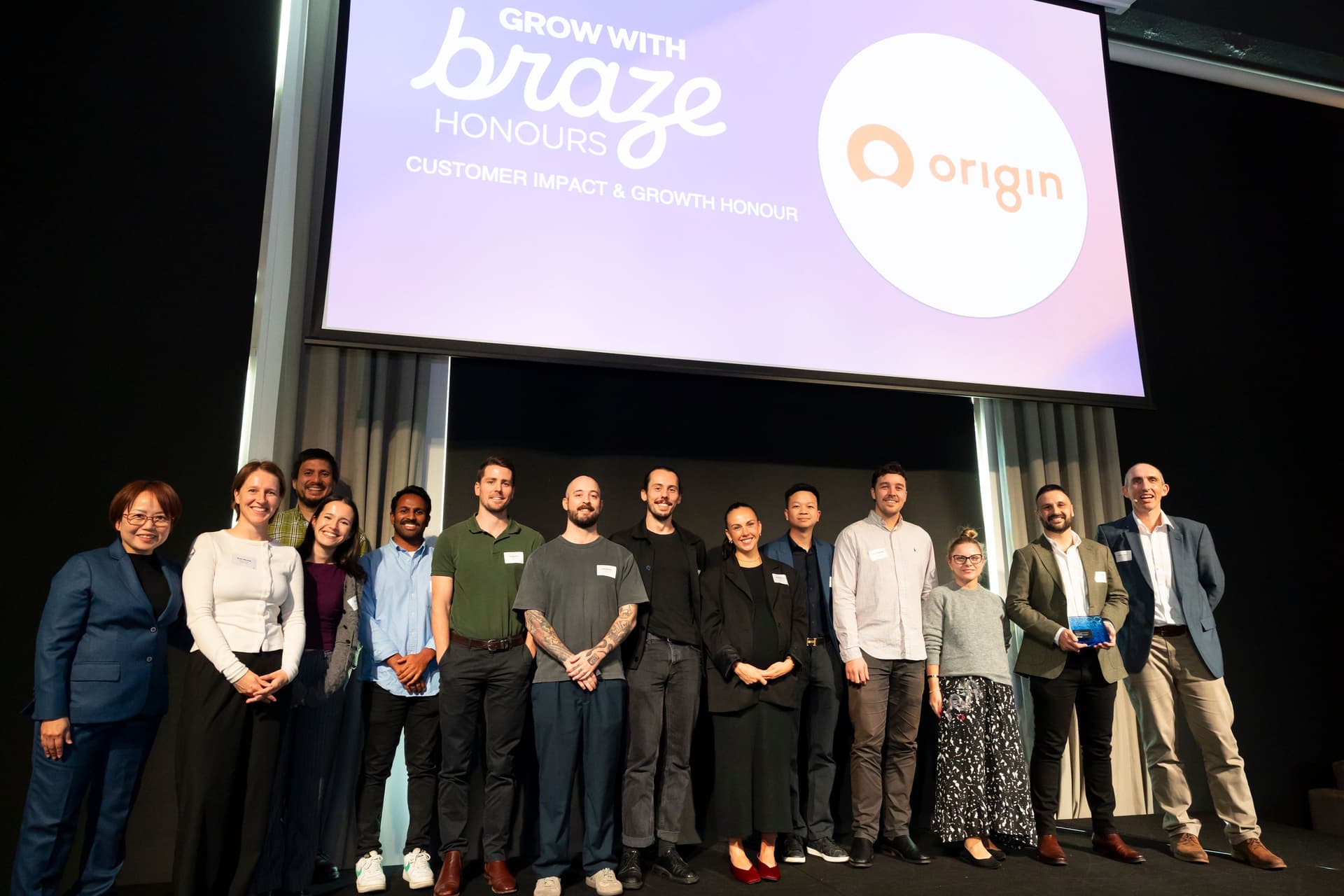
This year saw the inaugural Grow with Braze Honours ceremony come to Melbourne, celebrating brands that have pushed the boundaries of what is possible with Braze.
The Customer Impact and Growth Honour went to Origin Energy, Australia's largest energy retailer. The winning campaign, a highly-personalized 'Fifty Percent Off Internet' cross-sell to nearly two million existing energy customers, set a new bar for what orchestration at scale looks like in practice.
Origin reached those customers across Content Cards, email, push, and in-app messaging, all woven together via Braze Canvas and Braze Tags. Email achieved a 62% open rate across the campaign, while Content Cards alone generated more than 1.1 million unique impressions and were a strong contributor to total campaign conversions. For the in-app message deployed as the final channel touch before campaign end, Origin ran a holdout control group that proved a 238% uplift in conversions directly attributable to the Braze IAM.
Ashley Crane, presenting the award on stage, highlighted what distinguished this submission from an already exceptional field: the rigour of the A/B testing programme, the use of holdout control groups to prove incrementally, and the clarity with which every result could be connected back to a specific Braze orchestration decision. This was not a great campaign. It was a masterclass in using data to know what is working and then doing more of it.
"That is what happens when you send the right message, to the right customer, at the right time: a 62% email open rate at scale in a utilities context."
Five takeaways for Australian marketers
• The data activation gap is the real competitive advantage. ANZ brands rank highest globally for AI-assisted customer understanding, yet most are still not acting on that intelligence in real time. The gap between knowing and showing is where growth lives.
• Intent signals are more valuable than stated preferences. Whether it is an NBL fan who viewed a show page, a Canva user who clicked a Contact Sales CTA, or a Live Nation follower who opted into a presale, demonstrated behavior consistently outperforms what customers say they want.
• Experimentation is a discipline, not a feature. The standout brands on stage, Adairs with 60+ A/B tests in twelve months, Origin Energy with five distinct tests across channels, and Canva with self-running Canvas architectures, treat testing as the engine of continuous improvement, not a project for Q4.
• AI is most powerful when it reduces friction, not just effort. The most compelling AI stories were not about replacing marketers. They were about collapsing the time between a signal and a response: a data sync that took hours now takes minutes, a campaign that took twelve hours to build now runs itself, a segmentation decision that required SQL now happens in the UI.
• Trust is built at the channel level. Building direct relationships that hold up when AI agents begin mediating more interactions requires earning individual trust at every touchpoint, which means relevant content, transparent data use, and value exchanges that customers actually want to make.
Growth as a practice, not a destination
As the afternoon moved into networking drinks and live music courtesy of Contentful, the energy in the room carried a particular quality: Not just inspiration, but readiness. The stories shared across the afternoon were not aspirational. They were live, in production, delivering results right now, for Australian brands, with Australian customers.
The through-line from the NBL's fan data platform to Canva's self-running newsletter to Origin Energy's record-breaking cross-sell is the same one Ashley identified at the start: The brands winning are not the ones with the most data. They are the ones closing the gap between intelligence and action, in the moments that matter, at the individual level.
Grow with Braze Melbourne 2026 made one thing clear: AI is no longer the future of customer engagement. It is the present. And the teams who will lead are the ones already building the foundations to make every interaction feel like it was designed for exactly this person, at exactly this moment.
Related Tags
Be Absolutely Engaging.™
Sign up for regular updates from Braze.