The marketer’s guide to Conversational AI: What it is and how it works
Published on April 03, 2026/Last edited on April 03, 2026/9 min read


Lexie Haggerty
Senior Product Marketing Manager, BrazeThey say you can tell a lot about a person by how loudly they scream “Speak to a representative!” into their phone after a dead-end interaction with a chatbot. We’ve all been there: Trapped in a fruitless loop powered by rigid, rules-based logic that simply doesn’t understand what we need.
But those frustrating experiences are rapidly moving into the rearview mirror, thanks to a new era of AI. Basic two-way interactions once limited by pre-defined scripts are being replaced by robust, human-like conversations. They’re powered by a new term you might have heard floating around: Conversational AI (CAI), which provides specific, contextual responses rooted in a deep, real-time understanding of the customer.
If you’re a marketer looking to integrate this technology into your customer engagement strategy, read on to learn the fundamentals of CAI, how it works, and how it can help you set your brand apart.
What is Conversational AI?
At its core, Conversational AI (CAI) enables computers to understand and respond to human language in a natural, fluid manner. It isn’t just about chatting; it’s about facilitating human-like dialogue. CAI works by combining foundational large language models (LLMs), brand-specific context, and Natural Language Processing (NLP) to facilitate human-like dialogue through the use of AI agents.
Let’s break it down further:
How it works
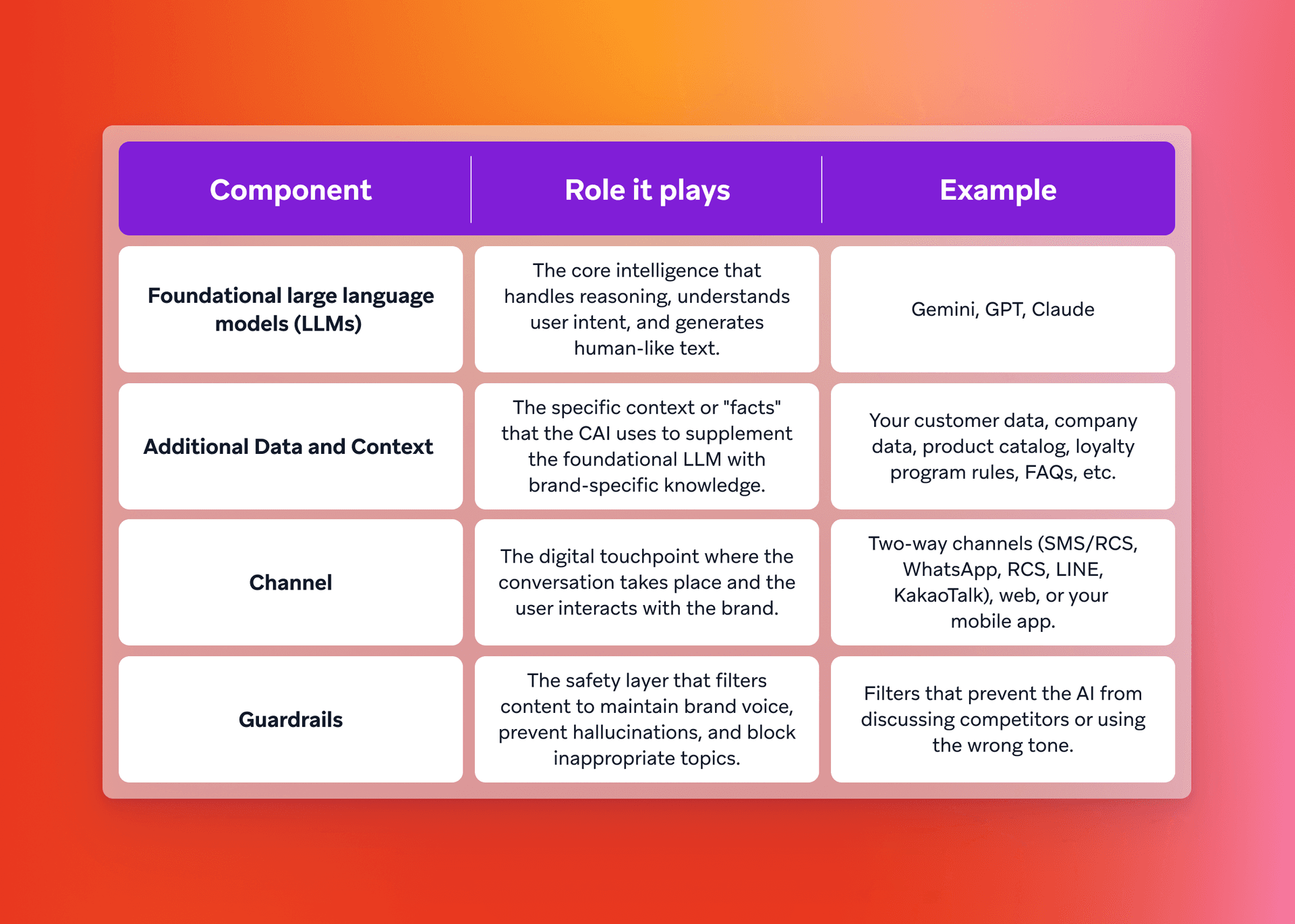
Before a response reaches a customer’s screen, a sophisticated process occurs under the hood. For marketers, understanding these components is key to building a strong CAI strategy. You don’t need to be an AI expert—you just need to know enough to be dangerous! Let’s take a look at all the components that power a conversational AI interaction.
Bringing it all together
A foundational LLM is a powerful engine, but it isn't ready for your customers out of the box. It needs to be given relevant and accurate context to respond in a way that sounds and feels like your brand.
Let’s look at how these components work together. Pretend you’re a marketer for an eCommerce skincare brand building a virtual beauty assistant:
- The agent & LLM: You prompt your AI agent (powered by a foundational LLM) to act as a "skincare expert" with the goal of helping customers find the right products for their needs.
- The context: You give the agent context by connecting it to your product catalog, customer data, and FAQs, including detailed descriptions of each product and the specific skincare concerns they treat.
- The interaction: A customer reaches out on a channel like WhatsApp asking, "What should I buy for my dry skin?"
- The reasoning: Instead of just providing a link to a generic quiz, the agent uses its reasoning to engage in a dialogue. It might analyze the customer's past purchase history to avoid duplicates and recommend a custom routine based on the specific product knowledge you’ve given it.
- The guardrails: Throughout the chat, guardrails ensure the agent stays on brand, only recommends products you actually sell, and maintains a helpful, professional tone.
By combining the "brain" of the LLM with your brand's specific knowledge, the agent delivers a concierge-style experience that feels human, but scales effortlessly.
Conversational AI vs. traditional chatbots
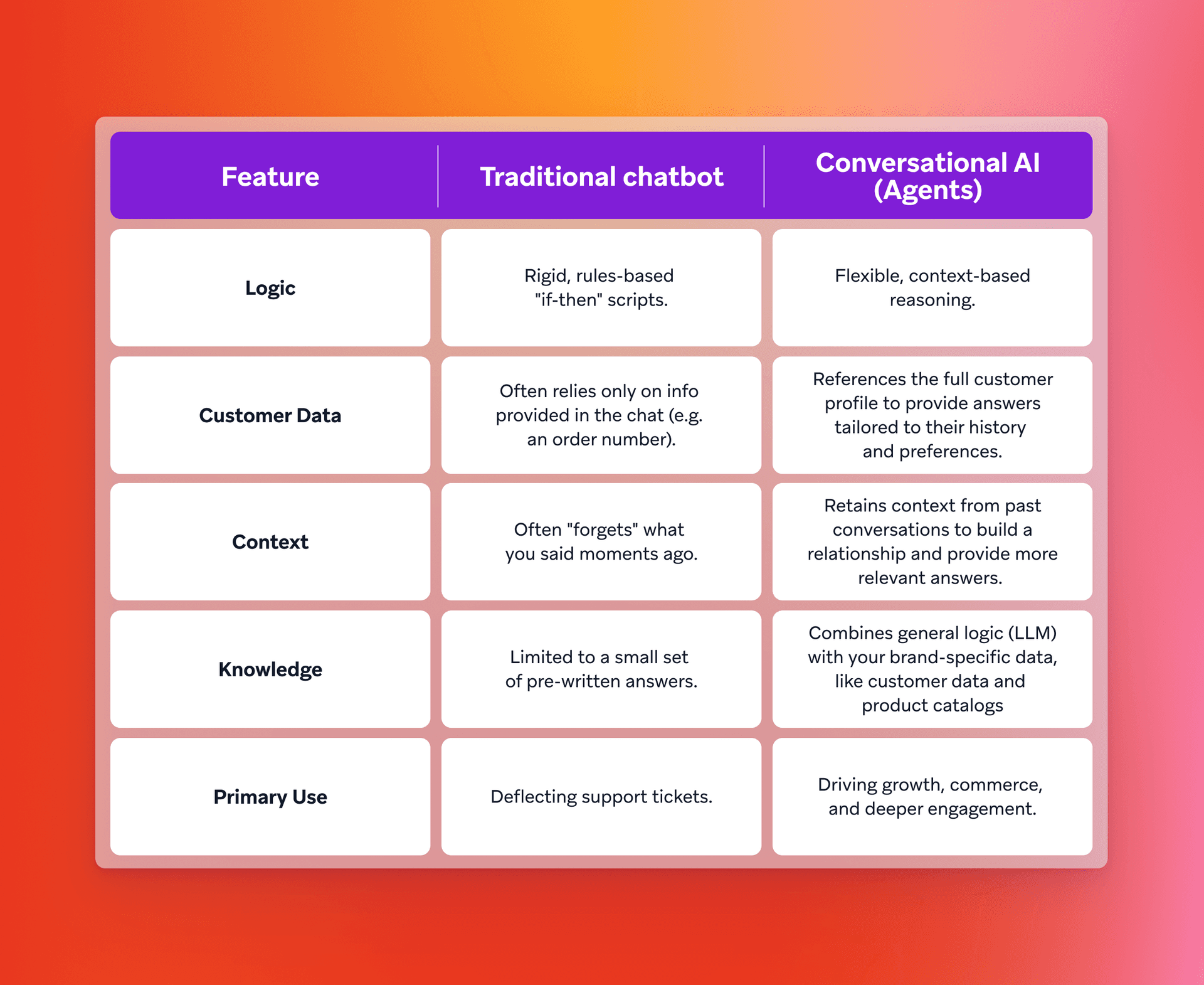
To help soldify your knowledge of this cutting-edge technology, let’s take a look at how it compares to the chatbots of the past. The difference isn't just technical; it’s a total shift in the customer experience.
Why marketers need CAI now
In 2026, one-sided marketing campaigns—what we call "digital shouting"—simply don't work. As brands continue to produce more content to gain market share, billions of marketing messages are ignored or deleted. Brands today are getting lost in the crowd and need new, compelling ways to stand out; in fact, 52% of consumers say that most brands they see online have no memorable distinction, according to the 2026 Global Customer Engagement Review.
Consumers want connection. 78% of customers are already messaging with brands on messaging apps like WhatsApp—and they love it because today's consumers value quick, direct communication. The benefits of CAI for the modern marketer include:
- Meeting customers where they are: Instead of forcing customers to a website, you can conduct a full, rich interaction inside the messaging apps they already use, like WhatsApp or SMS/RCS.
- Building two-way value exchanges: Conversations allow you to give and receive. Instead of a one-way "Buy this!” or “Take this action!" push, you can ask clarifying questions to provide a better recommendation, turning a promotion into a helpful service.
- Driving frictionless commerce: By addressing product concerns in real time, you save the customer the work of doing their own research. Serving up a message with a "Buy Now" CTA makes the final conversion effortless.
- Smarter handoffs: When a conversation gets too complex for an AI, the "hand-off" to a human agent is seamless. The agent receives a full summary of the AI’s chat, so the customer never has to repeat themselves.
Use cases for inspiration
Now for the fun part: How can you apply this cutting-edge technology to your business to drive deeper customer engagement and meaningful business results? Use cases for Conversational AI generally fall into three categories:
1. Marketing
Leveraging conversational AI for marketing is more of an emerging use case, so if you’re looking to get ahead of your competition, consider incorporating it into your customer engagement efforts. The industry spearheading the effort? Retail and eCommerce, where brands often use conversational AI as a virtual shopping assistant. Imagine a customer walking into a brick-and-mortar store. They might ask an associate about new arrivals, hot trends for the season, or even a product recommendation based on their preferences. Now, AI can do the same thing, serving up consultative, concierge-style experiences based on your customer’s preferences and other data. If you’re a marketer in the luxury space or other industries with longer or higher consideration purchase cycles, this is a high-touch strategy that can help better serve your high-value customers.
But conversational AI isn’t limited to retail; it can be used across a wide variety of industries for promotional and transactional campaigns. Think helping customers booking travel and finding the right hotel room, flight, or rental car. Providing patient support and making appointment scheduling easier in the healthcare industry. Or providing personalized financial advice. The possibilities for high-touch, human-like interactions are nearly endless. Check out some use case ideas below:
- Product and content recommendations: Instead of a static "You Might Also Like" email, the AI engages in a quick, real-time chat to surface a specific item based on the user's current mood, intent, preferences, or even the local weather.
- Virtual shopping concierge: This takes discovery a step further by acting as a consultative expert. Through a natural, back-and-forth dialogue, the agent learns about the user's specific needs—like their skin concerns, fit preferences, or style aesthetic—to make bespoke recommendations, like capsule wardrobe essentials or a multi-step skincare routine.
- Onboarding: Proactively guide new users through their first interaction, answering "How-to" questions in real-time to prevent early friction. Agents can also collect missing profile details through natural conversation—ensuring a complete setup without ever forcing the user to leave the messaging channel they’re already on.
- Win-back campaigns: When a user shows intent to cancel or churn, an agent can initiate a dialogue to understand their specific frustrations. By listening to the "why," the agent can offer a hyper-personalized incentive or alternative plan tailored to the customer’s feedback to encourage them to stay.
2. Conversational commerce
Think of conversational commerce as if marketing and customer support had a baby. These use cases often bridge the gap between marketing and CX, making conversational commerce well-suited for a variety of other industries where support and sales collide. For example, let’s say a customer sends your retail brand a message to return an item. CAI could start a conversation to determine what was wrong with the item and recommend something that will better suit the customer’s needs. Or media companies that often update a customer’s service or plan during a support call could move those flows to a CAI agent. Check out some more ideas below:
- Product deep-dives: Answering granular questions like "Will this serum work with my oily skin?" or "What are the exact dimensions of this bag?"
- In-thread transactions: Allowing a user to confirm a purchase, select shipping, and pay—all without leaving the chat window.
- Abandoned cart: Instead of a generic reminder, the AI asks if the user has a specific question about the item that's holding them back.
3. Customer Support
Leveraging chatbots to handle support tickets has been feasible for a long time, and now customer support is getting a major update with conversational AI and agentic technology.
Using conversational AI as your first line of defense is a fast and convenient way to help your customers get issues resolved, and reduce reliance on your customer support team or live agents. And consumers are on board, too. According to Statista, 82% of consumers stated they would use a chatbot instead of waiting for a customer representative to take their call and an overwhelming 96% of surveyed shoppers believed that more companies should opt for chatbots over traditional customer support services. Here are some ideas:
- Process returns and exchanges: Allowing customers to initiate a return, select a replacement, and receive a return label without ever calling a hotline.
- Proactive order updates: Giving conversational status updates like, "Your package is two stops away—would you like me to notify you when it lands?"
- General FAQs: Instantly answering common questions about store hours, loyalty points, or warranty policies using your brand's own internal knowledge base.
Industry Inspiration
- Retail: Imagine a personal shopper that allows users to ask, "Do you have any bags that match these shoes?" or "Can you notify me when this is back in stock in a size 8?" A luxury brand could use a consultative flow to ask about lifestyle preferences before returning the perfect handbag recommendation.
- MEGS (Media, entertainment, gaming, and sports): Think of a "game-day assistant" that answers fans' questions like, "Where is the closest place to get a hot dog with the shortest line?"
- Financial services: Imagine a virtual financial advisor that messages a user: "I noticed you’ve reached your savings goal for the month! Would you like to walk through a few options for where to put that extra $500?”
- Travel: Imagine a virtual travel agent that turns a delay into a conversation. Instead of a "flight delayed" alert, the agent messages: "Your flight to JFK is delayed by two hours. I found three lounge options nearby where you can wait, or I can help you rebook on the 6:00 PM flight now—which would you prefer?"
Final thoughts
Conversational AI is transforming marketing from a one-way “push” of campaigns into a series of two-way interactions. By moving away from digital shouting and toward genuine, context-based dialogue, brands can finally give customers what they’ve always wanted: to be heard, understood, and helped in real time.
Related Tags
Be Absolutely Engaging.™
Sign up for regular updates from Braze.