
What is customer data and how should you be using it?
Published on April 01, 2026/Last edited on April 01, 2026/10 min read


Team Braze
Personalization pays. According to Deloitte Digital, brands that excel at it are 48% more likely to have exceeded their revenue goals than peers that don’t. They’re also 71% more likely to report improved customer loyalty. Customer data is the difference between those two groups.
The bottleneck usually sits between collection and action. Braze research found that 80% of brands felt they were already collecting too much data. The harder problem is making it useful—getting it out of siloed systems, aligning it across teams, and activating it at a moment when it still means something to the person on the other end.
AI has shifted what's possible when customer data is well-structured and connected. Real-time personalization, cross-channel orchestration, decisioning that responds to live customer signals—all of it depends on having the right data foundation in place.
This guide covers what customer data actually is, which types drive meaningful engagement, and how leading brands are building the infrastructure that makes intelligent, real-time marketing possible.
TL;DR
- Customer data is essential for personalized, real-time marketing engagement, with AI and well-structured first-party data enabling brands to deliver relevant, timely, and continuous customer experiences while maintaining responsible data management.
Key Takeaways
- Customer data includes demographic, behavioral, and preference information collected from direct interactions, and its value lies in being connected and activated to create relevant, personalized experiences.
- AI enhances customer data use by analyzing real-time behavioral signals to predict actions and optimize personalized marketing at scale, surpassing static segmentation and fixed rules.
- Responsible data management, focusing on transparency, consent, and first-party data collection, builds customer trust and ensures compliance with privacy regulations, forming a strong foundation for effective engagement.
What is customer data?
Customer data is information collected from the interactions people have with a brand—across websites, apps, emails, purchases, support conversations, and more. It spans who someone is, what they've done, and how they've responded over time, building into a picture of preferences and behavior that gets more useful the richer it becomes.
A database full of events and attributes isn't the same as understanding a customer, though. The value comes when that raw data is connected and activated. For example, when a series of product views, an abandoned cart, and a pattern of late-evening app sessions stop being separate records and start pointing toward what a customer actually needs next.
Context is what makes the data useable and gives brands the opportunity to offer value on a 1:1, scalable level.
Why customer data matters
Customer data is important because it’s what allows brands to treat people as individuals rather than audiences. Without it, every message is a guess—the same offer, the same timing, the same channel, sent to everyone and relevant to very few.
Generic experiences underperform and erode trust. A customer who receives a promotion for something they bought last week, or a re-engagement message for an app they use daily, notices the disconnect. It signals that a brand isn't paying attention—and that's a hard impression to walk back. The customer journey is made up of dozens of small moments, and each one is an opportunity to either reinforce the relationship or damage it.
Good customer data makes three things possible:
- Relevance—knowing what someone has done makes it possible to anticipate what they might want next
- Timing—knowing when they tend to engage means reaching them at the right moment
- Continuity—knowing their history across channels makes it possible to pick up the conversation where it left off, rather than starting from scratch every time
When that data is incomplete, siloed, or out of date, those moments collapse. A missed signal becomes a missed opportunity, and enough of those add up to a customer who stops engaging.
Types of customer data
Not all customer data carries the same weight. Some tells you who someone is. Some tells you what they've done. And some—the most actionable kind—tells you what they're likely to do next. Here's how the main types break down, and where each one earns its place.
First-party customer data
First-party customer data is information collected directly from your own customers through your own channels—app activity, website behavior, purchase history, email engagement, loyalty interactions, and anything else captured with consent. Because it comes straight from the source, it's the most reliable data a brand can hold. It's also increasingly the only kind worth building on, as third-party signals have grown harder to access and have become less dependable.
Behavioral and engagement data
Behavioral data is the record of what customers actually do—what they click, what they ignore, how often they open the app, what they browse without buying, and when they tend to be most active. This is the data type most valuable for engagement and decisioning, because it reflects real intent rather than what demographics alone might suggest. A customer's actions tell you far more about what they want than their age or location ever could.
Contextual and preference signals
Contextual data covers the circumstances around an interaction—device, location, time of day, channel. Preference signals come from what customers tell you directly—their communication preferences, content interests, and frequency settings. Together, these add the layer of nuance that stops personalization from feeling formulaic. Knowing someone prefers email over push, or tends to engage on weekday mornings, shapes not just what you say but how and when you say it.
Customer data vs customer data platforms
A customer data platform (CDP) is a tool designed to collect, unify, and organize customer data into a single profile—pulling together information from a CRM, an email platform, a mobile app, a point-of-sale system, and anywhere else interactions happen. If you're a brand dealing with fragmented data across multiple systems and teams, this unification is extremely valuable.

What a CDP doesn't do on its own is act on that data. A unified customer profile is a better starting position, but the profile itself doesn't send a message, trigger a journey, or make a decisioning call. That requires an engagement layer that can read live customer signals and respond to them—increasingly, with AI making those calls in real time. Tools like Braze sit at that intersection, translating unified customer context into the next best action across channels.
How AI changes the role of customer data
Static segmentation captures the customer based on a fixed set of assumptions at a single point in time. However, customer behaviors and preferences can evolve, meaning that segments built on past data may no longer accurately reflect current realities or opportunities by the time they are used.
In comparison, AI and real-time data means that behavioral signals feed directly into customer profiles as they happen. The picture of who someone is and what they need, stays current.
Across millions of customer profiles and data points, AI can identify combinations of signals—a lapse in app sessions followed by a price-check, or a spike in browsing activity ahead of a seasonal event. No human analyst would have the bandwidth to do this consistently at scale.
These patterns become the basis for predictions, such as which customers are likely to churn, which are ready to convert, and which are drifting toward disengagement. Acting on those predictions gives marketing teams the ability to reach the right customer before the moment passes.
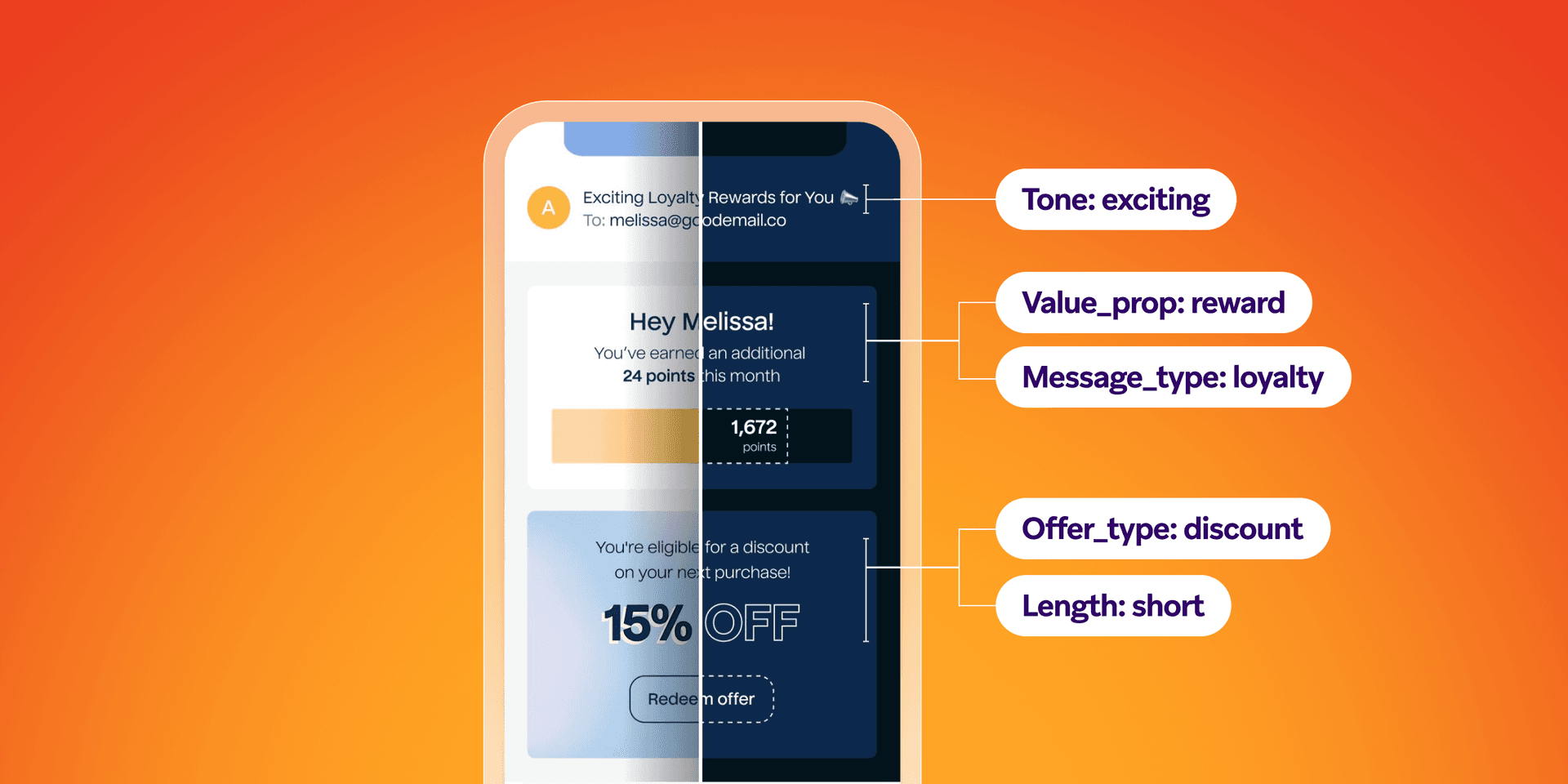
AI decisioning is where that process reaches its most sophisticated form. Using reinforcement learning, systems like BrazeAI Decisioning Studio™ run continuous 1:1 experiments for each individual—across message, channel, offer, and timing—updating their approach based on what's working and what isn't. Predicting what action a customer might take next turns into driving the next engagement, which is a better and more valuable experience all round.
What all of this depends on however, is data quality. A predictive model trained on incomplete behavioral signals will identify the wrong customers as at-risk. An AI decisioning system working from fragmented profiles will optimize confidently in the wrong direction. In other words, the sophistication of the AI won't reach its full potential if the reliability of what it's working with is shaky—which is why building a solid data collection strategy is the foundation everything else rests on.
Building a customer data strategy
A good customer data strategy starts with a clear question. What are you actually trying to do with the data? Collecting more isn't the same as collecting better. Begin with a specific use case, like an abandoned cart campaign or a churn prevention program, and then identify the exact data points needed to make it work.
From there, the focus shifts to quality and accessibility, and responsible customer data management. Data that's inaccurate, duplicated, or siloed across systems can't power real-time engagement. A well-structured strategy covers not just what to collect, but how it's organized, who can access it, and how quickly it feeds into the systems making decisions.
Customer data and personalization
The difference between personalization that works and personalization that falls flat usually comes down to context. Knowing a customer's name, or even their last purchase, isn't enough to make an experience feel relevant. Context is the fuller picture—what someone has been doing recently, how their behavior has changed, what they responded to last time and what they ignored. Without it, personalization is surface-level at best.
Rules-based personalization is still how many brands operate, and for good reason—it's logical, controllable, and relatively straightforward to implement. If a customer bought product A, show them product B. If they haven't opened in 30 days, send a re-engagement message. The limitation is that those rules are fixed and manual intervention becomes impossible at scale.
Fixed rules can’t account for the nuance of individual behavior, and they don't improve over time. A customer who bought product A last year and has since moved in a completely different direction will still get shown product B, because the rule doesn't know any better.
AI-informed personalization works from the full customer profile rather than a single trigger. It weighs behavioral history, real-time signals, and preference data together to determine what's most relevant for each individual at a given moment—not what's most relevant for the segment they happen to belong to. And AI decisioning tests and combines contextual signals to serve each customer with a truly 1:1 experience. Sitting alongside customer journey analytics, teams can also see where personalization is working across the full lifecycle, and where context is breaking down.
Responsible customer data management
Responsible customer data management starts with trust—being transparent about what data you collect, how clearly you explain why you need it, and how easy you make it for customers to control their own preferences. Customers who feel confident a brand is handling their information with care are more likely to share more of it, making every subsequent interaction more relevant.
Consent is crucial to that dynamic. As privacy regulations tighten and customer awareness grows, the brands with the strongest data assets will be those that earned them—through clear value exchanges and preference controls that are easy to find and use.
First-party data is usually better data. It reflects real interactions between a customer and your brand, collected with their knowledge. Compared to third-party data—increasingly restricted and often of questionable accuracy—it gives a more reliable picture of who your customers are and what they actually want.
Brands that invest in building consented, well-structured first-party data are better positioned for what comes next—more resilient to privacy changes, and more trusted by the customers they're trying to reach.
See how activating your customer data can power smarter, more responsible customer engagement.
Related Tags
Be Absolutely Engaging.™
Sign up for regular updates from Braze.